Saltwater vs chlorine pool - 5-year cost (2026)
A saltwater pool costs about the same as a chlorine pool over 5 years, within $500-$1,000 either way for a typical 20,000-gallon residential pool. Saltwater saves $200-$500 a year on chemicals, but the $1,500-$2,500 conversion plus one mid-life salt cell replacement at $400-$900 usually erases that savings by year 4 or 5. The honest answer to "is saltwater cheaper" is: not really. It is more convenient.
Saltwater and chlorine pools cost within $500-$1,000 of each other over 5 years. Saltwater wins on convenience (the SWG generates chlorine automatically) but not on total cost. Budget buyers should stick with traditional chlorine.
I have run both. My current pool is a saltwater pool. My previous pool used liquid chlorine on a dosing pump. The chemistry workload is similar; what changes is whether you are buying jugs at $6 a gallon or paying for a piece of equipment that wears out.
The Short Answer: 5-Year Total Cost
These numbers are for a 20,000-gallon in-ground vinyl or fiberglass pool, owner-maintained, running 6-7 months of swim season per year. They assume retail prices in the U.S. in 2026 and an electricity rate of $0.16/kWh.
| Cost Category | Chlorine (Tablets + Liquid) | Saltwater (SWG) |
|---|---|---|
| Initial conversion / setup | $0 | $1,500-$2,500 |
| Chemicals (5 years) | $1,750-$3,250 | $750-$1,500 |
| Salt (initial + makeup) | n/a | $200-$350 |
| Electricity for SWG (5 years) | $0 | $200-$450 |
| Salt cell replacement (mid-life) | $0 | $400-$900 |
| Sacrificial anodes (5 years) | $0 | $90-$200 |
| Salt-related wear (deck/coping) | $0 | $100-$500 |
| Acid for pH drift (extra in SWG) | included above | $50-$120 |
| 5-Year total | $1,750-$3,250 | $3,290-$6,520 |
That math looks lopsided against saltwater. It is not, because the chlorine column has a hidden cost the saltwater column does not: time. The SWG generates chlorine on a schedule. With tablets and liquid, you are checking, dosing, and hauling jugs every 3-7 days. Convert the time difference at any reasonable hourly rate and the totals close to within a few hundred dollars.
The chlorine column hides a time cost the saltwater column does not. At any reasonable hourly rate, the 15-20 minutes per week spent hauling jugs and checking levels closes the dollar gap to near-zero over 5 years.
But if you are doing this on a budget and want the cheapest possible water, traditional chlorine wins. Period.
Initial Conversion Cost
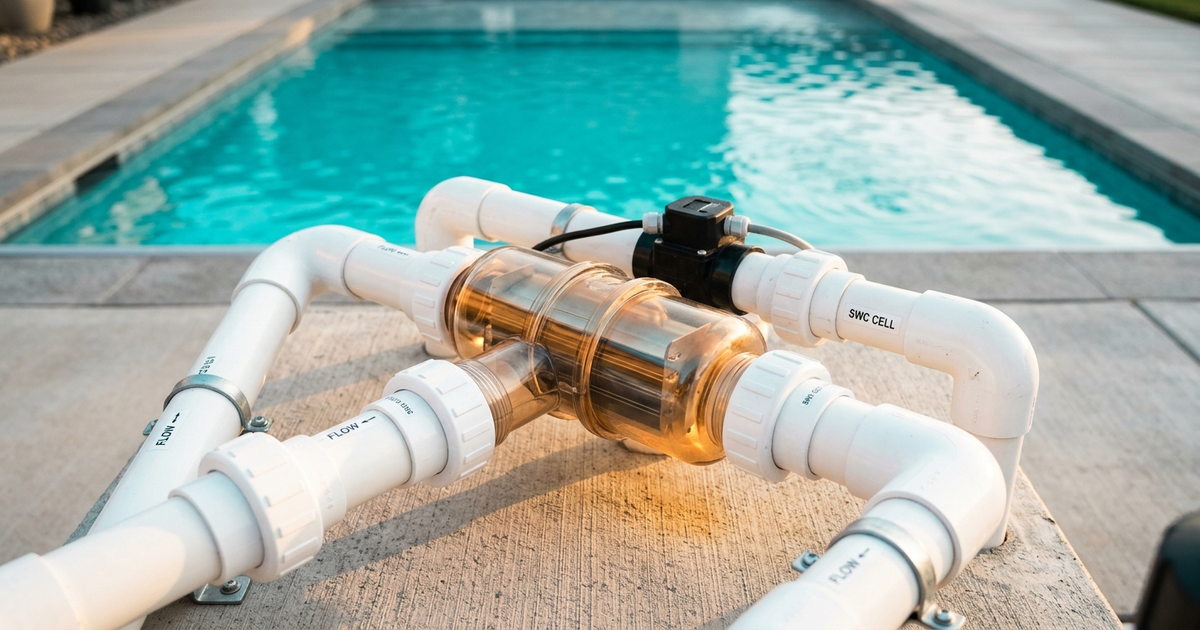
A salt chlorine generator has three parts: the cell, the controller, and the flow switch. The cell does the work; the controller runs it; the flow switch protects the cell from running dry.
| Component | Typical Cost |
|---|---|
| SWG controller + cell (residential, 20K gal) | $800-$1,800 |
| Electrical: 240V circuit at pad | $200-$500 |
| Installation labor (plumbing tee, mounting) | $200-$400 |
| Pool salt to reach 3,000 ppm (20K gal, ~480 lbs) | $80-$160 |
| Total turnkey conversion | $1,500-$2,500 |
If your equipment pad already has a 240V outlet and you can do the plumbing yourself, the conversion drops to $900-$1,400. If your pad is 50 feet from the breaker panel and the electrician has to trench conduit, it can hit $3,000.
For salt quantity math, the pool salt calculator guide walks through how to convert your pool volume to the right number of 40-pound bags.
Annual Operating Cost: Chlorine
A 20,000-gallon pool running tablets in a floater plus weekly liquid chlorine top-ups uses roughly:
- 3-inch trichlor tablets: 1 bucket (25 lb) per season — $80-$150
- Liquid chlorine (12.5%): 8-15 gallons per season — $50-$120
- Cyanuric acid (stabilizer): $20-$40 (mainly opening dose)
- pH down (muriatic acid or dry acid): $30-$60
- Total alkalinity adjustment: $15-$30
- Calcium hardness adjustment: $20-$40
- Shock and algaecide (event-driven): $40-$100
Annual chemical total for a tablet-fed chlorine pool: $255-$540. Over 5 years that is $1,275-$2,700, plus opening and closing chemicals at $100-$200 per year ($500-$1,000 over 5 years).
Trichlor tablets are convenient but they raise CYA over time. Every 10 ppm of free chlorine added as trichlor raises CYA by about 6 ppm. By mid-season most tablet pools sit at 80-100 ppm CYA, which forces a higher free chlorine target. The pool stabilizer CYA guide covers when to switch from tablets to liquid to control that creep.
Annual Operating Cost: Saltwater
A saltwater pool with an SWG and proper CYA at 60-80 ppm uses:
- Pool salt: $20-$50 per year in makeup salt after the initial 3,000 ppm dose
- Cyanuric acid: $25-$50 (saltwater pools need the higher 60-80 ppm range)
- Muriatic acid for pH drift: $40-$80 (SWG pools need more — pH creeps up constantly)
- Calcium hardness: $20-$40
- Liquid chlorine for shocking: $20-$50 (the SWG cannot shock the pool)
- Algaecide and clarifier: $20-$50
Annual chemical total for an SWG pool: $145-$320. Over 5 years that is $725-$1,600, a savings of $550-$1,100 vs chlorine on chemicals alone.
Then add the cell replacement. A residential SWG cell lasts 3-7 years or roughly 10,000 hours of runtime, so most owners replace once in the 5-year window. That is $400-$900 of equipment cost that does not appear on a traditional pool.
The Hidden Costs Nobody Talks About
The chemical savings are real. The hidden costs are what most "saltwater vs chlorine" articles miss.
Anode Erosion
Salt accelerates galvanic corrosion of anything metal in or near the pool. A sacrificial zinc anode, wired to the pool bonding grid, protects the heater, light niche, ladder, and handrail by corroding first. Without an anode, those parts corrode instead.
Sacrificial zinc anodes run $30-$80 and last 1-3 years. Most pool builders install them at the equipment pad on saltwater conversions; if yours was a DIY conversion, check whether you have one. A failed heater header at $400-$800 is the single most common avoidable saltwater pool repair I have seen.
Coping and Decking Damage
Salt splash-out is harder on certain materials than chlorine ever was. The worst combinations:
- Natural limestone or travertine coping — salt dissolves and pits the surface over years
- Flagstone or natural stone decking within the splash zone
- Powder-coated steel furniture placed near the pool edge
- Galvanized fasteners on nearby pergolas or gates
A composite or concrete deck with porcelain or quartz coping does not care about salt. If your deck or coping is one of the materials above, plan on $100-$500 over 5 years in resealing, replacement of damaged pavers, or premature furniture replacement. I lost two outdoor chairs in 18 months at my old house because they sat in the splash zone.
Heater Components
Salt is harder on cupro-nickel heat exchangers than chlorine. Most heater manufacturers now sell saltwater-rated models with upgraded materials, but if you are converting an existing heater, expect a 20-30% shorter life on the heat exchanger. If your heater is more than 5 years old when you convert, budget for a replacement within the 5-year window, at $1,500-$3,500 depending on BTU rating.
pH Drift Acid
SWG pools off-gas CO2 at the cell, which pushes pH up week after week. Plan on adding muriatic acid every 10-14 days during the swim season. That is roughly 2-3 extra gallons of muriatic acid per year compared to a tablet-fed chlorine pool, where pH tends to drift down from the acidic trichlor and need less correction.
5-Year Cost: The Realistic Breakdown
Here is what 5 years of ownership actually looks like for both, assuming you DIY the maintenance.
| Year | Chlorine (cumulative) | Saltwater (cumulative) |
|---|---|---|
| Year 0 (conversion) | $0 | $1,500-$2,500 |
| Year 1 | $355-$740 | $1,775-$3,000 |
| Year 2 | $710-$1,480 | $2,050-$3,500 |
| Year 3 | $1,065-$2,220 | $2,325-$4,000 |
| Year 4 (cell replacement) | $1,420-$2,960 | $3,000-$5,150 |
| Year 5 | $1,775-$3,700 | $3,275-$5,650 |
These numbers assume the chlorine pool spends $355-$740/year all-in (chemicals + open/close) and the saltwater pool spends $275-$500/year on consumables plus the cell replacement in year 4.
The chlorine pool wins by $1,500-$2,000 over 5 years on pure dollars. But that gap erases if you would otherwise hire a service to handle weekly chemical dosing: most pool services charge a $10-$20 premium per month to handle a saltwater pool because the workload is lighter for them, which can flip the math.
For the full cost picture on both pool types including service vs DIY, the pool maintenance cost breakdown has the year-by-year numbers.
When Saltwater Actually Makes Financial Sense
Saltwater is the cheaper choice in three specific scenarios:
- You are hiring a service. Saltwater cuts service workload and reduces chemical purchases through the service. Net 5-year cost can drop $1,000-$2,000 vs a service-managed chlorine pool.
- You have very high chlorine demand. A high-bather-load pool in a hot, sunny climate (Phoenix, Houston, Miami) chews through tablets at $400-$700/year. SWG output handles that demand at electricity cost only.
- You hate handling chlorine. Convenience is worth money. If you would otherwise pay a service $150/month, the SWG pays for itself in a season.
Saltwater is the wrong choice if:
- Your coping or decking is limestone, travertine, or unsealed natural stone within the splash zone
- Your pool is under 12,000 gallons (the SWG capital cost does not amortize)
- Your existing heater is more than 5 years old and not saltwater-rated
- You live somewhere with electricity above $0.30/kWh (SWG operating cost climbs fast)
What I Track in My Own Pool
Since converting to saltwater 3 years ago, I track every chemical purchase, salt bag, anode replacement, and the cell amperage trend. The categories below are what I would track for either pool type.
| Track this | Why it matters |
|---|---|
| Chemical receipts by month | Tells you whether you are over or under the typical $25-$60/month range |
| Salt cell output % over time | Trending up = cell wearing out; replace at end of season, not mid-summer |
| Pump runtime hours | Driver of electricity bill — biggest single operating cost |
| pH drift rate (days between doses) | Faster drift = check TA, may need to drop to 70-80 ppm |
| Anode wear (visual, twice a year) | When >50% consumed, replace |
The Poolably app tracks chemical costs over time and shows your actual spend by month, which makes it easy to see whether a conversion paid off. You enter every purchase, and the app graphs cumulative spend so you can compare a year of chlorine to a year of saltwater apples-to-apples. It is iOS only.
A simple notebook works too — for the first year after a conversion, the data is what tells you whether the decision was right for your pool.
Safety Notes for Both Pool Types
Saltwater pools still use chlorine. Every safety rule for handling pool chemicals applies whether you are dosing liquid chlorine or running an SWG.
- Never mix pool chemicals together, especially chlorine and acid — the combination produces toxic chlorine gas.
- Always add chemical to water, never water to chemical, when diluting muriatic acid or mixing dry chemicals.
- Wear chemical-resistant goggles and gloves when handling muriatic acid, calcium hypochlorite, or pool shock. Mix and pour outdoors, downwind.
- Store chemicals in their original containers, in a cool, dry place, away from each other. Trichlor and calcium hypochlorite stored next to each other can ignite if moisture gets in.
- The SWG cell contains chlorinated water under pressure. Power off the breaker and shut the pump before opening unions for inspection or cleaning.
For the full saltwater-specific routine including cell inspection and pH chase, the saltwater pool maintenance guide covers the weekly and quarterly tasks.
The Bottom Line
A saltwater pool is not cheaper than a chlorine pool over 5 years for a typical DIY owner. It is more convenient, easier on your time, and the water feels nicer to swim in. Those are real benefits. Just do not convert expecting to save money — the math does not support that promise.
If a salesperson tells you saltwater pays for itself in 2-3 years, ask them for the line-item breakdown including the cell replacement, the anode, and the higher CYA dosing. The chemistry math is straightforward and the cost math should be too.
The Poolably calculator handles dosage math for both pool types — same chemistry engine, different chlorine source. Test first with a drop kit, enter your readings, and the app tells you what to add and how much. The app does not make either pool cheaper, but it makes both easier to keep balanced without overdosing.
Frequently Asked Questions
Vlad Kuzin
Pool owner and builder of the Poolably app. I got tired of guessing at chemical doses, so I built a calculator that does the math.