Pool maintenance cost - what to budget in 2026
Pool maintenance runs $80-$300/month for a typical 20,000-gallon in-ground pool. The biggest line item is not chemicals. It is the labor you pay a service to test water and add acid. Full DIY maintenance for the same pool costs $25 to $60 per month in chemicals plus about 15 minutes of your time per week. The published "annual pool cost" numbers floating around the internet (typically $1,200 to $1,800) are mostly correct, but every article quoting them stops short of breaking down where the money goes and which line items you can cut without compromising water quality.
I have maintained my own 22,000-gallon pool for four years. The first year, I paid a service $180 a month and watched the technician spend 12 minutes per visit. The second year I switched to DIY and tracked every receipt. My total chemical and electricity spend that year was $864. That is the difference this article is about.
DIY pool maintenance costs $25-$60/month in chemicals and 15 minutes/week. Full-service runs $150-$300/month. The $1,200+/year difference is almost entirely labor for tasks you can learn in an afternoon.
The Full Annual Breakdown
Here is what a 20,000-gallon in-ground chlorine pool actually costs to run for a year. Numbers reflect 2026 pricing for a temperate U.S. climate with a 6-7 month swim season. Your costs will vary by region (Sun Belt pools run longer; Northeast pools have higher opening/closing labor).
| Line Item | DIY Cost | Full Service Cost | Notes |
|---|---|---|---|
| Chemicals (chlorine, acid, CYA, etc.) | $300-$700/yr | Included in service | Service buys wholesale, charges retail |
| Weekly maintenance labor | $0 (your time) | $1,200-$2,400/yr | 30 visits at $40-$80 each |
| Pool opening / spring start-up | $100-$150 | $300-$500 | DIY: shock + algaecide + filter clean |
| Pool closing / winterization | $80-$150 | $300-$600 | DIY: cover + plugs + antifreeze + shock |
| Electricity (pump) | $300-$1,200 | $300-$1,200 | Same for both — see pump section |
| Filter media replacement | $30-$300 | $50-$500 | Sand every 5-7 yrs, cartridge every 1-3 yrs |
| Water (top-off + partial drains) | $20-$100 | $20-$100 | Same for both |
| Minor repairs and parts | $50-$200 | $100-$400 | O-rings, gaskets, baskets |
| Total annual | $880-$2,800 | $2,270-$5,700 | Difference is mostly labor |
The DIY savings range from $1,400 to $2,900 a year for a typical residential pool. That is the entire reason this article exists. A $200-a-month service contract works out to $2,400 per year, and after you strip out the wholesale-cost chemicals the service is including, you are paying $1,800-$2,000 for labor and drive time.
What You Actually Spend on Chemicals
Chemical costs scale with pool volume, climate, sanitizer type, and how disciplined you are about pH. For a 20,000-gallon outdoor chlorine pool in a 7-month season, expect these volumes:
| Chemical | Typical Annual Use (20,000 gal) | Retail Cost (2026) |
|---|---|---|
| Liquid chlorine (12.5% sodium hypochlorite) | 25-50 gallons | $150-$350 |
| Muriatic acid (31.45%) | 4-8 gallons | $60-$120 |
| Cyanuric acid (stabilizer) | 4-8 lbs | $20-$40 |
| Calcium chloride (if needed) | 10-30 lbs | $20-$60 |
| Pool shock (cal-hypo or dichlor) for vacation/storms | 4-8 lbs | $30-$80 |
| Algaecide (optional, polyquat 60) | 1-2 quarts | $30-$60 |
| Test strips or refill reagents | 1-2 kits | $20-$60 |
| Total | $330-$770 |
Two cost drivers most articles ignore: cyanuric acid mistakes and over-shocking. If your CYA climbs above 80 ppm because you used excess trichlor tablets, your free chlorine becomes ineffective and you end up dumping shock to compensate, easily $100-$200 of wasted chlorine per season. I cover the math behind this in the CYA-chlorine relationship guide, but the short version is: tablets are convenient, but they raise CYA roughly 6 ppm per pound of trichlor, and once CYA is too high your only fix is partial drain and refill.
The Pool Chemical Calculator Guide walks through the math for converting any test reading into a dose for your specific pool volume. Doing this correctly is the difference between a $300 chemical year and a $700 chemical year.
The Weekly Service Charge: What You Are Paying For
A typical $40-$80 per-visit service includes:
- Test the water (5 minutes, test strips or a Taylor kit)
- Dose chemicals (3-5 minutes, pour and walk)
- Empty skimmer and pump baskets (2 minutes)
- Skim the surface (5 minutes)
- Backwash or check filter pressure (5 minutes)
Total: 20-22 minutes of actual work per week, including the truck-to-pool walk. The technician usually services 8-12 pools per day at this pace.
The math on the labor charge is straightforward. A pool company charges $60 per visit, pays the technician $20-$25, spends $5-$10 on the chemicals they dose, and pockets $25-$30 in margin plus overhead and drive time. There is nothing wrong with this. It is a legitimate service. But you should know what you are buying: convenience, not expertise.
If you DIY, the same 15-20 minutes per week saves you $40-$80. Over a 30-week season, that is $1,200 to $2,400 in your pocket.
What DIY Weekly Maintenance Actually Looks Like
Here is the routine I run. The whole thing takes 12-18 minutes once you have the habit:
- Test water with strips or a kit (3 min). Free chlorine, pH, total alkalinity, CYA monthly. Test strips are the cheapest viable option and are accurate enough for routine adjustments.
- Empty the skimmer basket and pump basket (2 min).
- Skim the surface and brush one wall (5 min). Rotate which wall each week.
- Dose chemicals based on the test results (3 min). Liquid chlorine, muriatic acid, or stabilizer as needed.
- Check filter pressure (1 min). Backwash or clean the cartridge when it climbs 8-10 psi above baseline.
- Log the readings (1 min). Even a paper notebook is enough. The Poolably app does this automatically and calculates doses from your readings, useful if you want trend lines and drift alerts, but a notebook works.
For the chemistry of the test results themselves, the Pool Water Chemistry Guide covers what each reading means and what target ranges to hit. Free chlorine 2-4 ppm (higher if CYA is above 50), pH 7.4-7.6, total alkalinity 80-120 ppm, CYA 30-50 ppm for outdoor chlorine pools. These targets come from the CDC Model Aquatic Health Code and the PHTA water quality standard.
Safety basics that apply every time you dose chemicals: never mix pool chemicals together (especially chlorine and acid, which release toxic chlorine gas), always add chemical to water and never water to chemical, wear chemical-resistant goggles and gloves, and store chemicals in their original containers in a cool dry place, separated from each other. Muriatic acid and chlorine should not share a shelf.
Pool Opening and Closing: The Biggest DIY Wins
Annual opening (spring start-up) and closing (winterization) are the highest-margin services pool companies sell. They run $300-$500 each and take 1.5-2 hours of technician time, but you can do them with $80-$150 in supplies and a long afternoon.
Opening involves: removing the cover, reinstalling drain plugs, priming the pump, shocking the pool, balancing chemistry, and running the filter for 24-48 hours until the water clears. The pool opening checklist covers the full sequence with specific dosages and wait times.
Closing involves: deep-cleaning the pool, balancing chemistry to winter targets, lowering the water below the skimmer (in freeze climates), blowing out the lines, adding pool antifreeze, dosing a winter algaecide and shock, and installing the cover.
If you do nothing else DIY, do these two. You will save $400-$800 a year and the work is straightforward.
Opening and closing are the two highest-value DIY tasks. Do nothing else yourself and you save $400-$800/year. The work is straightforward and takes a Saturday each.
Electricity: The Sneaky Line Item
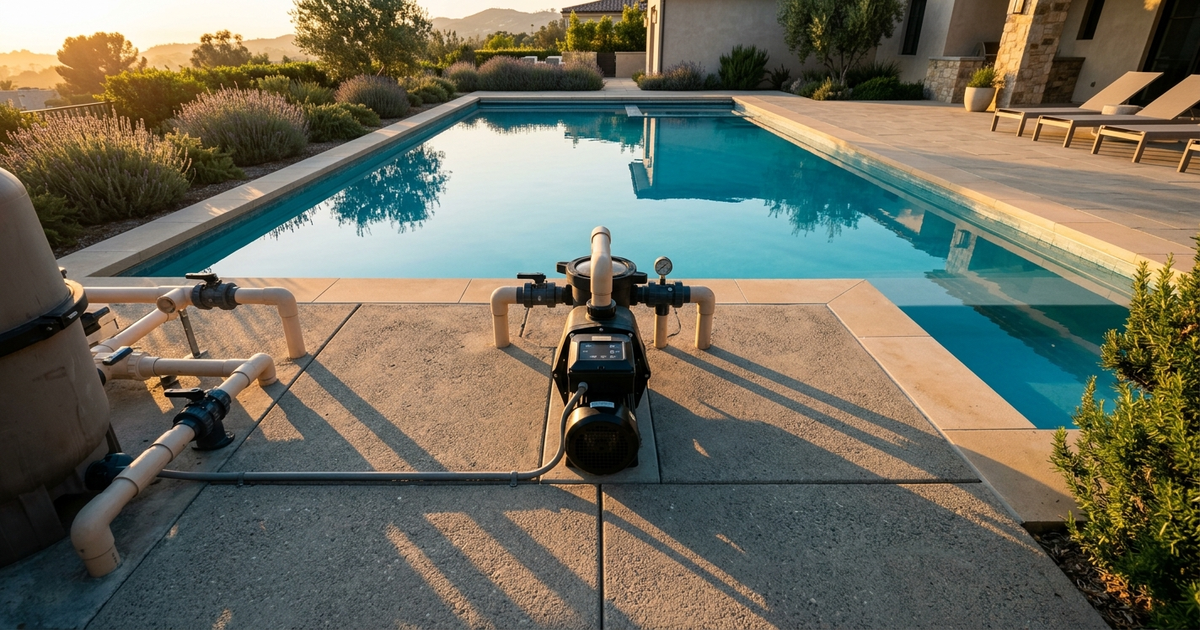
Electricity for the pump is the single largest non-labor expense for most pool owners, and the size of that bill depends almost entirely on your pump type and run time.
| Pump Type | Wattage at Operating Speed | Annual Cost (8 hrs/day, $0.16/kWh, 365 days) |
|---|---|---|
| Single-speed 1.5 HP | 1,500-2,200 W | $700-$1,030 |
| Two-speed (low) | 250-400 W | $120-$190 |
| Variable-speed (1,400 RPM filtration) | 150-300 W | $70-$140 |
| Variable-speed (2,800 RPM cleaning) | 800-1,200 W | $380-$560 (limited use) |
The U.S. Department of Energy's dedicated-purpose pool pump standard (10 CFR 431, effective 2021) requires variable-speed for most replacement pumps over 0.711 total HP. If you still have a single-speed pump from before 2021, replacing it with a variable-speed model costs $700-$1,400 installed and pays back in 1-3 years on the electricity savings alone.
A VS pump running 12 hours per day on low speed typically uses less electricity than an old single-speed pump running 8 hours per day on high. The reason is fluid dynamics: pump power scales with the cube of flow rate, so cutting flow in half cuts power consumption by about 87 percent.
Saltwater Pool Maintenance Cost
Saltwater pool maintenance runs $80-$160 per month in operating costs, slightly less than a chlorine pool because you stop buying liquid chlorine or tablets. But the salt chlorine generator (SCG) adds long-term costs that change the annualized math:
| Saltwater-Specific Expense | Cost | Frequency |
|---|---|---|
| Salt (pool-grade NaCl) | $5-$8/40 lb bag | Initial fill: 8-12 bags ($40-$100). Top-off after rain/splash-out: 2-4 bags/year |
| Salt cell replacement | $400-$900 | Every 3-7 years depending on water chemistry |
| Sacrificial anode (optional but recommended) | $40-$80 | Every 2-4 years |
| Increased muriatic acid use | +$30-$60/year | SCGs raise pH, so you dose acid more frequently |
| Cell scaling acid wash | $0 DIY, $100-$150 service | Every 3-6 months |
Amortized over 5 years, a saltwater pool runs $50-$150 cheaper per year than a chlorine pool on chemicals alone, but only if you DIY the cell cleaning and replacement. Pool services charge $200-$300 to swap a cell that costs the homeowner $500 in parts; the labor is removing eight bolts and reconnecting two wires.
The chemistry behind why salt cells scale (high pH from electrolysis byproduct + calcium hardness) is covered in the pool calcium hardness guide. The practical takeaway: keep pH below 7.8 in a saltwater pool, and the cell will last 5-7 years instead of 3.
DIY vs Service: A Decision Tree
Not everyone should DIY. The honest version:
Hire a weekly service if:
- You travel more than 4 weeks a year during swim season
- You have physical limitations that make pump-room work hard
- You value 15 minutes per week of your time at more than $40/hour after taxes
- You are renting the property and the landlord pays
- You have a public-facing rental or Airbnb where chemistry liability matters
DIY if:
- You are home most weekends
- You enjoy fiddling with the pool (it happens)
- You are budget-conscious, and the $1,500-$2,000 a year matters
- You have the storage space for chemicals (a locked outdoor cabinet, away from the house)
Hybrid: hire only the high-margin services. Pay a service for the spring opening ($300-$500) and fall closing ($300-$600), and DIY the weekly chemistry between them. You get the heavy seasonal work done by a pro and skip the part where you are paying $180 a month for 20 minutes of testing.
What Most Cost Articles Get Wrong
Three common mistakes in the "pool maintenance cost" content you will read elsewhere:
1. Conflating chemicals with service. Articles quote "$300-$600 per year in chemicals" and "$1,500 per year total" without explaining that the $1,200 gap is almost entirely labor. The chemicals do not change whether you DIY or pay; the labor does.
2. Ignoring electricity. A single-speed pump can cost $1,000 a year on its own. A variable-speed pump can cost $80. That $920 swing is bigger than the entire chemical budget, and most articles bury it in a sentence.
3. Treating "pool maintenance" as one number. Opening and closing are seasonal, with about $600-$1,100 of service cost concentrated into two appointments. The other $1,200-$1,800 of an annual service contract is the weekly visits. You can mix and match: DIY weekly, pay for seasonal, or the reverse. The math changes a lot depending on which slice you outsource.
Hidden Costs Most Budgets Miss
Things that do not show up in monthly maintenance estimates but will hit your wallet sooner or later:
- Pump motor failure: $300-$700 for the motor, $150-$300 for installation labor if you do not DIY. Typical lifespan 8-12 years on a residential pump.
- Heater repair: Gas heater service runs $200-$500; a full replacement is $2,500-$5,500. Heaters need annual maintenance even if you DIY everything else. Gas appliances are the one area where I do not recommend DIY unless you are a licensed plumber or HVAC tech.
- Liner replacement (vinyl): $1,500-$4,500 every 8-12 years.
- Plaster resurfacing (gunite): $4,000-$8,500 every 10-15 years.
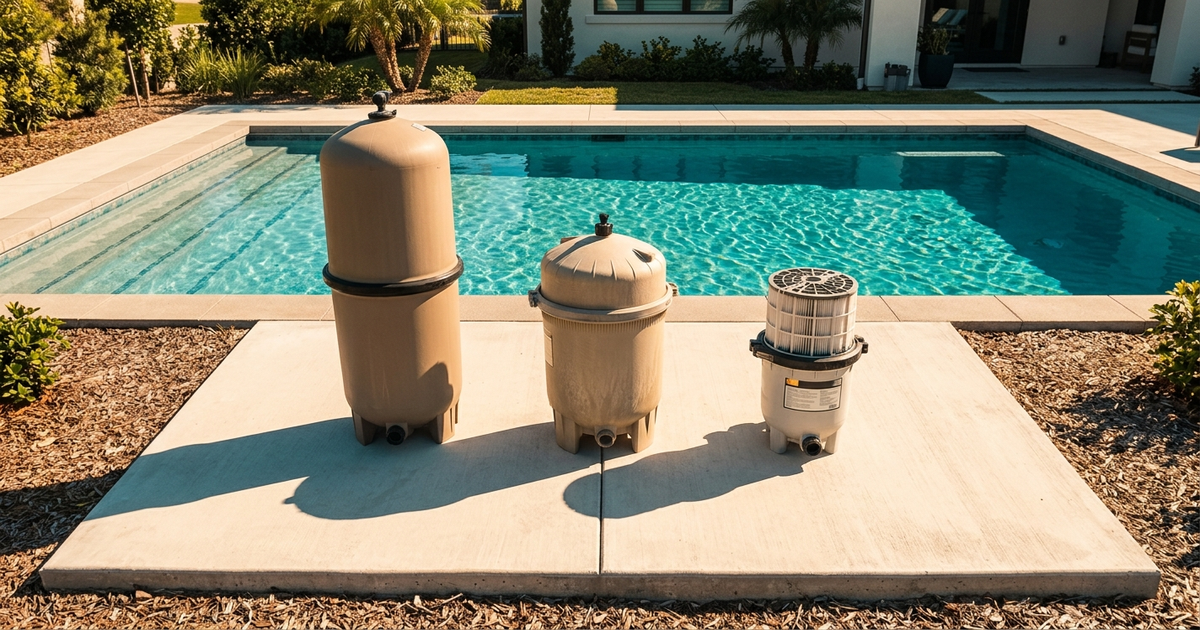
- Filter media: Sand replacement every 5-7 years ($150-$400). Cartridge replacement every 1-3 years ($100-$400 per cartridge depending on filter size). DE grids every 7-10 years ($150-$500).
- Cover replacement: A solid winter cover lasts 5-8 years and costs $200-$600 for a residential pool. Mesh safety covers run $1,500-$3,500 and last 12-15 years.
- Salt cell: $400-$900 every 3-7 years for saltwater pools (covered above).
Build $400-$800 a year into your budget as a sinking fund for these. They will not happen every year, but they will happen.
Where the Poolably App Fits
The Poolably app's dosage calculator accounts for your actual pool volume and current readings, so you do not have to do the chemistry math by hand each week. It tracks your test results over time, calculates doses for liquid chlorine, muriatic acid, baking soda, CYA, and calcium chloride, and shows drift before it becomes a problem. It is iOS only, and it does not test your water, so you still need a test kit or strips. If you only adjust chemistry once a month and you are comfortable with the math in the pool chemical calculator guide, a notebook and a calculator app work fine. The app earns its keep when you are tracking five parameters all season and want the trend lines and the dose math in one place, basically when you are doing the work a $180-a-month service used to do.
Frequently Asked Questions
How much does pool maintenance cost per month in 2026?
Full-service pool maintenance runs $100 to $300 per month for a residential in-ground pool, depending on region and pool size. DIY chemical maintenance for the same pool runs $25 to $60 per month, plus about 15 minutes of your time per week. The difference is almost entirely labor — you are paying $80 to $240 a month for someone to test, dose, and skim.
How much does pool maintenance cost per year?
Total annual cost for a 20,000-gallon in-ground pool ranges from about $880 to $2,800 fully DIY, $2,270 to $5,700 with monthly service, and higher if you add a heater, weekly service, and unplanned repairs. Electricity for the pump is the single largest non-service expense at $300 to $1,200 per year, swinging on whether you run a single-speed or variable-speed pump.
Is it cheaper to maintain a pool yourself?
Yes, by $80 to $240 per month. A typical full-service contract is $150 to $200 per month and covers about 20 minutes of actual work per visit — testing water, dosing chemicals, emptying baskets, and skimming. The chemicals themselves cost the service $25 to $50 per visit; the rest is labor and overhead you can keep.
Why is pool maintenance so expensive?
About 60 to 75 percent of a monthly pool service bill is labor and drive time. Chemicals at retail prices run $25 to $60 per month for a typical 20,000-gallon pool, and the testing takes about 5 minutes. Most homeowners hire a service because of time and hassle, not because the chemistry is hard — the actual work is mechanical and repetitive.
How much does saltwater pool maintenance cost?
Saltwater pool maintenance runs $80 to $160 per month for chemicals and salt, slightly less than chlorine because you stop buying liquid chlorine or tablets. The catch is the salt cell, which costs $400 to $900 to replace every 3 to 7 years. Amortized over the cell's lifespan, saltwater costs about the same as chlorine — sometimes $50 to $150 a year less if you DIY the cell replacement.
How much should I budget for unexpected pool repairs each year?
Set aside $400 to $800 a year as a sinking fund for repairs and replacements that will not happen every season but will happen eventually. The biggest items are pump motor replacement ($450 to $1,000), heater service or replacement ($200 to $5,500), filter media ($150 to $400 every few years), and cell replacement on saltwater pools ($400 to $900 every 3 to 7 years).
Does pool size affect maintenance cost?
Yes, but less than people assume. Chemical costs scale roughly linearly with volume — a 30,000-gallon pool uses about 50 percent more chemical than a 20,000-gallon pool. Service prices scale less than that, because the labor time is similar regardless of pool size. Electricity scales with pump size and run time, not pool volume. The biggest cost drivers are sanitizer choice, pump type, and whether you DIY — not pool size.
Frequently Asked Questions
Vlad Kuzin
Pool owner and builder of the Poolably app. I got tired of guessing at chemical doses, so I built a calculator that does the math.