Saltwater pool chlorinator - how it works
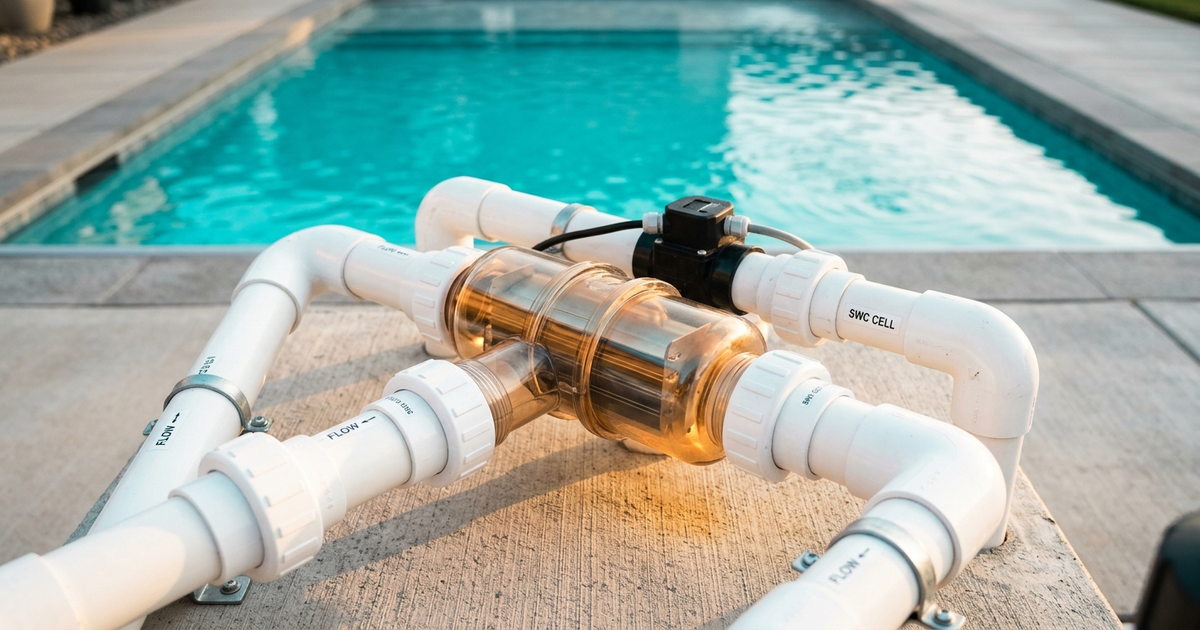
A saltwater pool chlorinator generates chlorine by passing low-voltage direct current through saltwater, which splits the salt (sodium chloride) and water into hypochlorous acid, the same active sanitizer in a jug of liquid chlorine. The reaction happens inside a replaceable cell containing titanium plates coated with ruthenium oxide. That cell is the most expensive wear part on a saltwater system: $400-800 every 3-7 years.
Cell replacement is the single biggest line item in saltwater pool ownership after the original equipment. Most owners overspend on it by acid washing too aggressively, running salt at the bottom of range, or installing a cell that is too small for the pool. This article covers how the cell actually works, the four signs it is failing, and the maintenance habits that get you to year seven instead of year three.
The salt cell is the most expensive wear part on a saltwater system: $400-800 every 3-7 years. Running salt at 3,200-3,500 ppm (not the minimum 2,700) and avoiding unnecessary acid washes extends cell life by 1-2 years.
How a Salt Cell Generates Chlorine
The cell is a flow-through chamber with a stack of parallel titanium plates wired alternately to positive and negative terminals. When the pump pushes saltwater through the cell at the correct flow rate (typically 15-25 gallons per minute), the controller applies 24-28 volts DC across the plates and pulls 3-8 amps depending on output setting. That current drives electrolysis.
At the cathode (negative plate), water splits into hydrogen gas and hydroxide ions. At the anode (positive plate), chloride ions from the dissolved salt give up an electron and combine into chlorine gas, which immediately reacts with water in the cell to form hypochlorous acid. The pump carries that hypochlorous acid into the pool, where it sanitizes the way any other form of chlorine does.
The reaction is reversible. After hypochlorous acid neutralizes a contaminant or breaks down under UV, the chloride ions return to solution. That is why a saltwater pool does not consume salt to generate chlorine; salt only leaves through splash-out, backwash, and rain dilution. A correctly running cell can recycle the same salt for years.
Reverse Polarity (And Why It Matters)
Modern cells from Hayward, Pentair, and Jandy reverse the polarity of the plates every 2-8 hours, depending on the model and the water hardness setting. Calcium scale forms on the cathode (negative plate) during normal operation; when polarity flips, that plate becomes the anode and the scale dissolves off into the water flow. This is why a healthy modern cell rarely needs acid washing.
If you find yourself cleaning the cell more than once a year, something else is wrong: calcium hardness too high, pH chronically above 7.8, or the reverse polarity cycle is no longer working because the cell is failing. Cleaning the symptom does not fix the cause. The same scale will be back in 30 days.
For more on calcium and how it forms on equipment, see pool calcium hardness levels.
What a Salt Cell Actually Costs Over Time
The chlorinator system has three parts: the controller (the box mounted on the wall), the cell (the flow chamber), and the flow switch (a small sensor that confirms water is moving). The cell is the only part that wears out on a normal schedule. The controller and flow switch typically last 10-15 years.
| Component | Typical Cost | Replacement Interval | Notes |
|---|---|---|---|
| Salt cell (mid-size, 25,000 gal rated) | $400-600 | 3-7 years | Hayward T-Cell-9, Pentair IC20 |
| Salt cell (large, 40,000 gal rated) | $550-800 | 4-8 years | Hayward T-Cell-15, Pentair IC40 |
| Controller | $400-700 | 10-15 years | Replace when board fails or surge damages |
| Flow switch | $30-60 | 5-10 years | Cheap, easy to swap |
| Salt (40 lb bag) | $8-15 | 1-3 bags per year | Top-off after rain dilution, splash-out |
A 20,000-gallon pool with a properly sized cell costs roughly $80-160 per year amortized for the cell alone. Smaller, undersized cells push that toward $200 per year because they run a longer duty cycle and wear faster. For where this fits into the full picture, annual pool maintenance cost breaks down the rest.
Four Signs Your Cell Is Failing
Test first. Before suspecting the cell, verify your water chemistry with a strip or kit. A "cell problem" is usually a chemistry problem: low salt, high pH, low free chlorine because CYA is wrong.
If chemistry checks out and you still see one of these signals, the cell is the issue:
1. Output drops despite correct salt level. Salt reads 3,200 ppm on an independent digital meter, but free chlorine keeps falling. The cell is producing less chlorine per amp-hour than it used to because the ruthenium oxide coating on the anode is worn through.
2. Controller reports low salt when salt is verified correct. This is the most common end-of-life signal. The controller measures salt by inferring conductivity from cell amperage at a known voltage. As the coating degrades, more voltage is needed to push the same current, and the controller interprets this as low salt. If your meter says 3,200 ppm and the controller says 2,400 ppm, the cell is telling you it is tired.
3. Visible damage to the plates. Pull the cell, hold it up to the light, and inspect the plates end-on. Healthy plates are flat, parallel, and uniformly dark gray. Failing plates show flaking (small black or gray particles in the cell housing), pitting, or one plate dramatically lighter than the others. Any visible damage means the cell has months left at most.
4. Cleaning every 2-3 months instead of annually. Reverse polarity should keep the cell scale-free under normal water chemistry. If you are acid washing four times a year, the coating is too worn to clear scale during polarity reversal. The first failure mode is usually a scaled cell that no longer self-cleans; the second is total output loss.
When to Clean Instead of Replace
Acid washing a cell is risky. Done correctly, it removes calcium scale and restores a few months of output. Done incorrectly, it strips the ruthenium oxide coating and ends the cell's life immediately. The line between "cleaning" and "destroying" is thinner than most pool owners realize.
Clean only if all three of these are true:
- You see visible white calcium scale between the plates that does not rinse off with a garden hose.
- The plates are intact (no flaking, no pitting, no dark/light asymmetry).
- The cell has not been acid washed in the last 6 months.
If those conditions are not met, replace the cell instead. A cell that has been acid washed three times in the last year is going to fail within the season, and buying another six weeks is not worth the risk of a failed cell during a heatwave.
How to Acid Wash Safely
This is the standard procedure manufacturers publish. Hayward, Pentair, and Jandy all specify a 4:1 water-to-acid ratio and warn against soaking longer than 10 minutes.
- Turn off the SWG controller and the pump. Confirm power is off before touching the cell.
- Close the isolation valves on either side of the cell if your plumbing has them. Otherwise plug the pump to prevent water from siphoning out.
- Unscrew the cell unions by hand and lift the cell out. Keep it vertical, because water will drain from the open ends.
- Rinse with a garden hose at full pressure, end to end. Most scale comes off with water alone. If the cell is now clean, skip the acid wash entirely.
- Mix 4 parts water to 1 part muriatic acid (31.45%) in a plastic bucket. Always add acid to water, never water to acid. Wear chemical-resistant goggles, gloves, and old clothes. Do this outdoors with the wind at your back.
- Cap one end of the cell with a manufacturer cleaning cap or a plastic bag held tight with a rubber band. Pour the acid solution into the open end until the plates are covered.
- Soak for 5 minutes maximum. Watch for bubbling; when bubbling slows, the reaction is done. If you see no bubbling at all, the cell did not have scale, and you should not have acid washed it.
- Pour the spent acid into a bucket of fresh water (acid to water, again), neutralize with baking soda until bubbling stops, and dispose per local rules.
- Rinse the cell thoroughly with a hose, reinstall, restore power, and run for 24 hours before retesting chlorine.
Never acid wash a clean cell, because each wash strips a layer of the ruthenium oxide coating. Clean only when scale is visible. A cell that gets acid washed monthly instead of every 3-6 months loses 1-2 years of life.
Never use more than 4:1 water-to-acid. Never soak longer than 10 minutes. Both shortcuts strip the coating and end the cell's life on the spot.
How to Extend Cell Life
Cell life is mostly determined by how hard the cell has to work. The four habits below stretch a 3-year cell into a 6-year cell.
1. Size Up When You Buy
A cell rated for double your pool volume runs at half the duty cycle. The Hayward T-Cell-15 is rated for 40,000 gallons; on a 20,000-gallon pool it runs at roughly 30-40% output to hold free chlorine, instead of the 70-80% a T-Cell-9 (25,000-gallon rated) would run. The plates spend less time under voltage, the coating wears slower, and you get years more life. The price difference at purchase is usually $100-150, cheap insurance against a $500-800 replacement two years sooner.
2. Hold Salt in the Middle of Range
Running a cell at the bottom of its salt range forces higher amperage to produce the same chlorine, which accelerates plate wear. Hayward's range is 2,700-3,400 ppm with a 3,200 target. Pentair's is 3,000-4,500 ppm with a 3,400 target. Jandy's is 3,000-4,000 ppm. Test salt with a digital meter monthly — controller salt readings drift by 200-400 ppm as the cell ages, and chasing the controller reading instead of the meter reading is how cells end up running at 2,500 ppm without the owner knowing.
The Poolably app tracks salt level over time and alerts when readings drop below your SWG's minimum, which catches slow rain-dilution drift before it stresses the cell. It is iOS only, and a digital salt meter is still required for the initial reading.
3. Keep Calcium Hardness In Check
Calcium scale forms on the cathode whenever calcium hardness is high and pH drifts above 7.8. Reverse polarity dissolves most of it, but high calcium overwhelms the cycle. Target calcium hardness at 200-400 ppm for plaster pools (lower half of range for SWG), 150-250 ppm for vinyl and fiberglass. Test calcium quarterly — it only rises (from evaporation and fill water mineral content), so a falling reading usually means a bad test.
4. Stop Acid Washing on a Schedule
The single most common cause of premature cell failure I see in saltwater forums is owners who acid wash every spring "as preventive maintenance." It is not preventive — it is destructive. The ruthenium oxide coating is a few microns thick, and every acid bath strips a measurable amount. Inspect the cell every 3 months, but only acid wash when you see scale that does not rinse off.
For more on day-to-day SWG operation and the chemistry differences between saltwater and traditional chlorine systems, the saltwater pool guide covers weekly maintenance, CYA targets, and pH drift.
Saltwater Chlorinator Sizing Cheat Sheet
Use this table to size a cell for your pool. Manufacturer rated gallons assume the cell runs at roughly 70% duty cycle for 8 hours a day in average climate. Always size up for hot climates, high bather load, or if your pump runs less than 8 hours.
| Pool Volume | Minimum Cell | Recommended Cell | Notes |
|---|---|---|---|
| Under 15,000 gal | 15,000 gal rated | 25,000 gal rated | Hayward T-Cell-3 / T-Cell-9 |
| 15,000-25,000 gal | 25,000 gal rated | 40,000 gal rated | Pentair IC20 / IC40 |
| 25,000-40,000 gal | 40,000 gal rated | 40,000 gal rated | Hayward T-Cell-15, Pentair IC40 |
| Over 40,000 gal | 40,000 gal rated | Two cells or commercial | Single residential cell will run 100% in summer |
Running a cell at 100% all summer is the fastest way to burn it out in 2 years. If your output is pinned at 100% and you still cannot hold free chlorine, the cell is undersized — replacing it with the same size is throwing money away.
Chemical Safety Notes
Acid washing a salt cell involves concentrated muriatic acid. Take these precautions every time.
- Never mix pool chemicals. Acid plus chlorine produces toxic chlorine gas. Keep the cell rinse step separate from any chlorine handling.
- Always add acid to water, never water to acid. Reversing the order causes a violent exothermic reaction that can splash acid out of the bucket.
- Wear chemical-resistant goggles and gloves. Splash from a 4:1 muriatic solution causes immediate chemical burns to skin and permanent damage to eyes.
- Work outdoors in well-ventilated areas. Muriatic acid releases hydrogen chloride fumes that irritate lungs and corrode metal — including the controller you are standing next to.
- Store muriatic acid in original containers, in a cool dry place, away from chlorine, oxidizers, and metals. The original HDPE bottle is rated for the contents; transferring acid to a metal can or a different plastic is a leak waiting to happen.
- Always turn off the SWG controller and the pump before removing the cell. Live voltage on the plates combined with acid is the worst-case version of this job.
When the Cell Dies Mid-Season
A cell that fails in July leaves the pool without sanitizer. While you wait for the replacement to arrive, dose liquid chlorine manually to hold free chlorine at the right level for your CYA — typically 4-7 ppm for SWG pools running 60-80 ppm CYA. A 1-gallon jug of 10% liquid chlorine adds roughly 5 ppm to a 10,000-gallon pool, so a 20,000-gallon pool needs roughly 0.4 gallons per day to compensate for sun loss.
This is also a useful sanity check before you replace the cell: if liquid chlorine restores normal water and the cell is producing nothing, the cell is dead. If liquid chlorine restores normal water and the cell was producing something, you may have had an undersized cell rather than a dead one — and the right fix is a larger cell, not a same-size replacement.
FAQ
How long does a saltwater pool chlorinator cell last?
A residential salt cell lasts 3-7 years, or roughly 10,000 hours of run time. Hayward rates the T-Cell-15 at 10,000 hours, and Pentair rates the IC40 at 10,000 hours. Water chemistry, salt level, and how aggressively you clean the cell all shift where you land in that range.
How do I know my salt cell is going bad?
Watch four signals: chlorine output drops even though salt level reads correct on a test strip, the controller reports low salt despite a verified 3,000-3,500 ppm reading, the cell needs cleaning every 4-6 weeks instead of every 3 months, and visible damage to the titanium plates (flaking, pitting, or one plate noticeably darker). Any one of these means the cell is near end of life.
How often should I clean my salt cell?
Inspect every 3 months. Acid wash only if you see visible white calcium scale between the plates that does not rinse off with a garden hose. Modern reverse-polarity cells are designed to self-clean during the polarity reversal cycle, so an annual acid wash is usually enough. Cleaning on a fixed schedule shortens cell life rather than extending it.
Should I clean my salt cell or replace it?
Clean it if the plates are visibly scaled but intact and the controller shows normal voltage and amperage. Replace it if the plates show flaking or pitting, if cleaning does not restore output, or if the cell is past the manufacturer rated hours. A cell that needs cleaning more than 4 times a year is failing.
What salt level should I run for the longest cell life?
Hold salt at the middle of your manufacturer's range, not the bottom. For Hayward AquaRite, target 3,200 ppm within the 2,700-3,400 range. For Pentair IntelliChlor, target 3,400 ppm within the 3,000-4,500 range. Running at the low end forces the cell to draw higher amperage to produce the same chlorine, which accelerates plate wear.
Can I install a bigger cell to extend its life?
Yes, and it is the single best thing you can do for cell longevity. A cell rated for 40,000 gallons running a 20,000-gallon pool runs at 30-40% duty cycle instead of 70-80%, which means the plates spend less time under load. The price difference between a mid-size and large cell is usually $100-150, which is far less than one extra cell replacement over the system's lifetime.
Do I really need an app for this?
No. If you test salt monthly with a digital meter, inspect the cell every 3 months, and keep a notebook of salt readings over time, you can run a saltwater pool indefinitely without any software. The Poolably app exists because I got tired of the notebook — it tracks salt, free chlorine, pH, and alkalinity over time and alerts when salt drops below the SWG minimum so I do not stress the cell by accident. The math is not hard. It is just easier to not do it manually.
Frequently Asked Questions
Vlad Kuzin
Pool owner and builder of the Poolably app. I got tired of guessing at chemical doses, so I built a calculator that does the math.