Saltwater pool guide - maintenance and chemistry
Saltwater pool maintenance means testing water chemistry weekly, inspecting the salt cell every three months, and treating the salt chlorine generator (SWG) as equipment that wears out. The system generates chlorine; it does not replace the work of keeping pH, alkalinity, calcium hardness, and CYA in range. Plan on roughly 15 minutes a week, plus a 30-minute cell check each quarter.
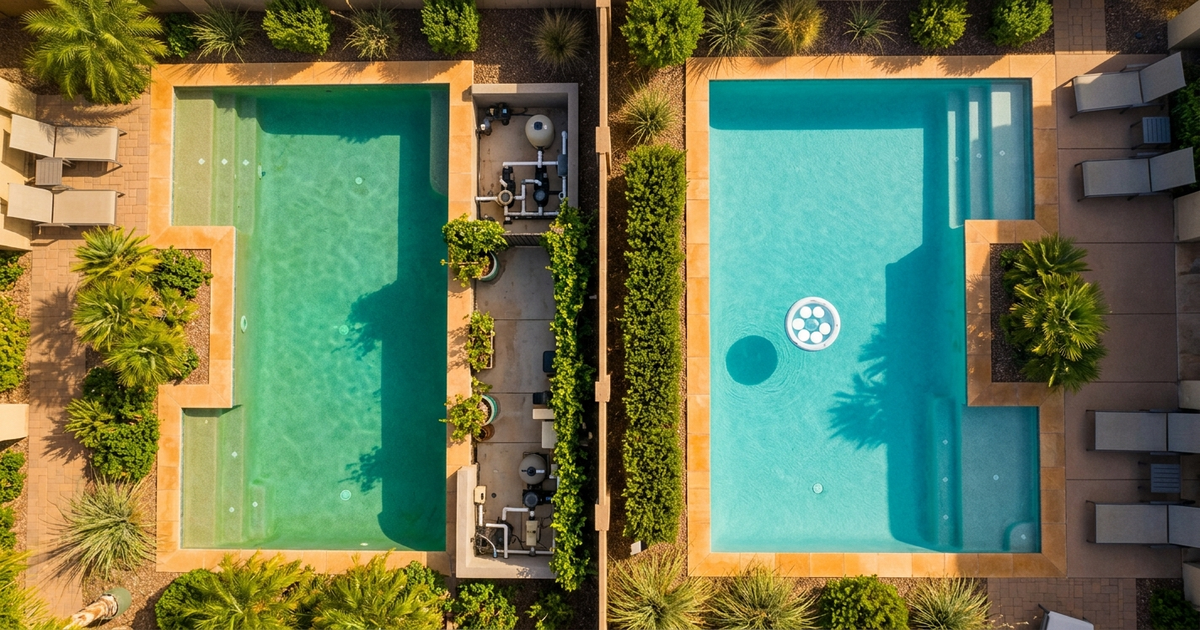
A saltwater pool is a chlorine pool. The chemistry I balance is almost identical to a traditional pool, with three real differences: a CYA target nearly double the traditional range, total alkalinity held at the low end to fight pH drift, and one more piece of equipment to monitor.
What "Saltwater Pool" Actually Means
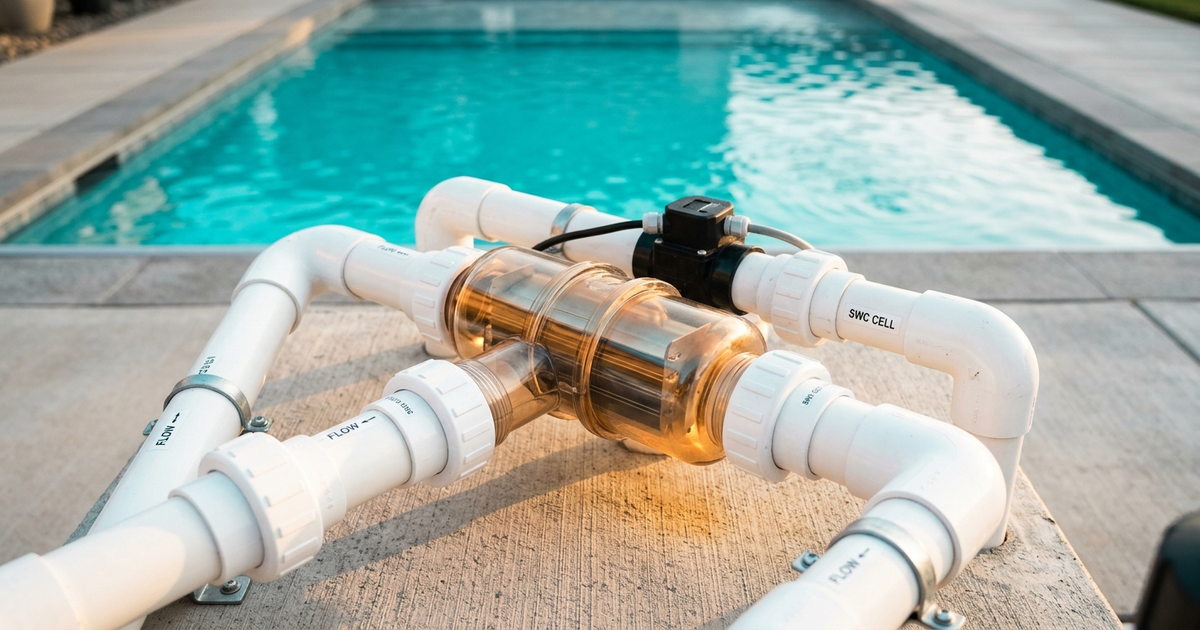
The SWG dissolves chlorine into the water by passing electrical current through saltwater across titanium plates. Hypochlorous acid (the same active sanitizer in a jug of liquid chlorine) comes out the other side. Salt does not get consumed; chlorine reverts to salt after sanitizing, and the cycle repeats.
The marketing problem is the phrase "saltwater pool." It suggests something fundamentally different from a chlorine pool, which leads new owners to assume the chemistry runs itself. It does not. Free chlorine still drops if the cell shuts off. pH still drifts. Algae still grows if CYA is wrong. Every test parameter on a traditional pool applies here, plus salt.
For background on how the cell works, the salt level math, and the most common myths, the pool salt calculator guide covers the basics. This piece focuses on what changes about maintenance once the cell is installed and running.
Chemistry Targets for Saltwater Pools
Test first, then dose. Targets below apply to a vinyl or fiberglass pool with a residential SWG; plaster and gunite pools need calcium hardness in the upper half of the range to protect the surface.
| Parameter | Target (SWG Pool) | Traditional Pool | Notes |
|---|---|---|---|
| Free chlorine (FC) | 4-7 ppm (at 70 CYA) | 3-5 ppm (at 40 CYA) | Set by CYA, not pool type |
| pH | 7.6-7.8 | 7.4-7.6 | Aim higher; pH drift is up |
| Total alkalinity (TA) | 70-80 ppm | 80-120 ppm | Lower TA slows pH rise |
| Calcium hardness (CH) | 250-450 ppm | 250-450 ppm | Lower end for vinyl, upper for plaster |
| Cyanuric acid (CYA) | 60-80 ppm | 30-50 ppm | UV protection for SWG output |
| Salt | 2,700-3,400 ppm | n/a | Check your unit's spec |
| Stabilizer ratio | FC = 7% of CYA | FC = 7-8% of CYA | Same chart applies |
A saltwater pool is a chlorine pool; the SWG just changes how chlorine enters the water. Every test parameter from a traditional pool still applies, plus salt level.
Two targets in this table get most saltwater pools in trouble, so I want to be specific about why.
CYA at 60-80 ppm, Not 30-50
SWG cells produce chlorine on a duty cycle. If your CYA is 30 ppm, UV breaks down the chlorine the cell just made within hours, and the cell has to run longer to hold the same free chlorine reading. Pushing CYA up to 60-80 ppm cuts UV burn-off significantly and lets the cell run a shorter cycle, which is easier on the cell, lowers power use, and gives a more stable free chlorine reading day to day.
Set CYA at 60-80 ppm for a saltwater pool, not the 30-50 ppm traditional range. Lower CYA forces the cell to run longer, wears it out faster, and wastes electricity.
The math behind this trade-off, including why FC needs to scale with CYA, is in the CYA and chlorine relationship guide. The short version for SWG owners: at 70 ppm CYA, your minimum free chlorine is around 3 ppm and your target range is roughly 4-7 ppm. Below that range, algae starts to outpace the sanitizer regardless of what the SWG display says.
Poolably's saltwater mode automatically uses the higher CYA target when calculating dose recommendations, which avoids the most common SWG newbie mistake: under-stabilizing the pool and then chasing a chlorine reading that never holds.
Alkalinity at 70-80 ppm
The standard pool advice is to keep TA at 80-120 ppm. For SWG pools, that range causes constant pH chase. The chlorine generation reaction at the cell creates a localized high-pH zone that drives off dissolved CO2, which pushes pool pH up over time. Higher TA accelerates that effect because there is more carbonate to off-gas.
Holding TA at 70-80 ppm slows the pH rise without sacrificing buffering. I aim for TA at 75 ppm in my own pool and add muriatic acid every 10-14 days during the swim season to keep pH in the 7.6-7.8 range. Lower TA than that risks pH instability and corrosion of metal components.
The Weekly Maintenance Routine
This is what I do every week from May through October:
- Skim, brush walls, and empty pump and skimmer baskets.
- Test free chlorine, pH, and total alkalinity with a drop kit.
- Glance at the SWG display for any low salt or service warnings.
- Adjust pH with muriatic acid if it has crept above 7.8.
- Set the SWG output up or down based on the free chlorine reading.
- Vacuum or run robot cleaner.
Once a month I add CYA and calcium hardness testing and a salt level check. Once a quarter the cell comes out for inspection.
Use a drop-based test kit (Taylor K-2006 is the standard) rather than strips for any week where you plan to adjust chemicals. Strips are fine for daily peek-and-go but lose accuracy on TA and CYA, which are the two readings you tune for an SWG pool. See the pool water testing guide for the full kit recommendation.
The SWG-Specific Tasks Most Owners Skip
Every problem I have seen with a saltwater pool (dead cells at year two, persistent algae, chlorine readings that look fine but smell wrong) traces back to one of these four tasks getting skipped.
Quarterly Cell Inspection
Every 3 months, shut off power to the SWG, unscrew the cell unions, and look between the plates with a flashlight. You are checking for white calcium scale. A modern reverse-polarity cell stays mostly clean on its own; a non-reversing cell, or any cell on hard water, will scale faster.
If the plates are clean, rinse the cell with a hose and reinstall. Do not acid wash a clean cell, because every acid bath etches the metal coating off the plates and shortens cell life.
If you see flaky white deposits more than 1/16 inch thick, the cell needs cleaning. Procedure:
- Power off the SWG breaker and verify the display is dark.
- Close the isolation valves on either side of the cell, or shut off the pump.
- Unscrew the cell unions and remove the cell.
- Rinse with a garden hose to knock off any loose scale.
- Mix a 4:1 solution of water and 31.45% muriatic acid in a non-metal bucket; add acid to water, never water to acid.
- Pour the solution into the cell housing until plates are submerged, no higher than the wiring.
- Soak 5-10 minutes maximum. Plates should be visible through the foaming.
- Pour the solution into the chemical neutralization bucket (baking soda in water) and rinse the cell with a hose.
- Reinstall, open valves, restart pump, then restore SWG power.
Wear chemical-resistant goggles and gloves the entire time. Muriatic acid will burn skin and eyes, and the fumes are corrosive. Mix outdoors, downwind. Never mix muriatic acid with anything except water, because combining it with chlorine, calcium hypochlorite, or other pool chemicals produces toxic chlorine gas. Store the acid in its original container, capped, in a cool dry place away from chlorine.
If the scale is heavy and a single soak does not remove it, your calcium hardness is too high or your pH has been running high for too long. Fix the chemistry first, or you will be acid washing the cell every quarter and burning through cells. The pool calcium hardness guide covers what to do about persistently high calcium.
Monitoring Cell Output
Salt cells degrade slowly. The first sign is not failure. It is the SWG running at higher output percentages to hold the same free chlorine reading. If you used to run at 40% and now need 70% to keep FC at 5 ppm, the cell is roughly 60-70% through its life.
Write down the output setting every month. When you start seeing a steady creep upward with no other chemistry change, plan on replacing the cell at the end of the season rather than mid-summer. A residential SWG cell typically lasts 3-7 years or about 10,000 hours of runtime.
Salt Level Verification
The SWG's built-in salt readout is not a test. It is a calculation based on cell amperage, which drifts as the cell ages. Test salt level with a separate device or test strip monthly. If the SWG reads 3,200 but a separate test shows 2,400, the cell is reporting wrong, and you risk running it dry of salt without warning. Below the manufacturer minimum (typically 2,500-2,700 ppm), the cell can damage itself trying to produce chlorine in low-conductivity water.
Pre-Storm and Pre-Party Shocking
The SWG cannot produce a shock dose quickly. Boosting to 100% output overnight raises free chlorine by maybe 2-3 ppm in a typical pool, nowhere near shock level. For real shocking, use liquid chlorine, not the SWG.
After heavy bather load, a thunderstorm, or any visible water cloudiness, calculate the shock target from your current CYA (the chlorine-CYA chart sets it; at 70 ppm CYA, shock level is about 28 ppm FC) and add liquid chlorine to reach it. The pool chemical calculator guide covers shock dosing math for any current FC and target. The Poolably app handles this calculation directly when you enter your readings.
Maintenance Calendar
This is the schedule I work to. Print it, screenshot it, whatever. The point is that none of these tasks are optional.
| Frequency | Task | Time |
|---|---|---|
| Weekly | Test FC, pH, TA; skim and brush; check SWG display | 15 min |
| Weekly | Adjust pH if above 7.8 (muriatic acid) | 5 min |
| Monthly | Test CYA, calcium hardness, salt | 10 min |
| Monthly | Empty pump basket, check filter pressure | 10 min |
| Quarterly | Visual cell inspection, salt verification | 30 min |
| Quarterly | Acid wash cell if calcium scale present | 30 min |
| Annually | Replace test kit reagents | 10 min |
| Every 3-7 yrs | Replace salt cell | 1 hr |
Common Saltwater Pool Problems
When something is wrong, the test results usually tell you which direction to look. This is the troubleshooting tree I use:
Free chlorine reads low or zero, SWG running:
- Check CYA. If below 50, raise to 70, because the chlorine is being UV-burned faster than the cell can make it.
- Check salt level with a strip. If below 2,700, add salt.
- Inspect the cell visually. Scale reduces output.
- Check water temperature. Most SWGs throttle output below 60°F.
- Boost SWG to 100% and add liquid chlorine to reach FC target while diagnosing.
pH consistently above 7.8:
- Lower TA to 70-80 ppm. Run aeration off, add muriatic acid in 8-12 oz doses per 10,000 gallons, wait 4 hours, retest. See the pool chemical calculator guide for full dosing math.
- Reduce SWG runtime if possible — shorter cycles, lower output, more days.
- If a water feature is running, turn it off. Aeration accelerates pH rise.
Salt cell shows "Low Salt" but salt tests fine:
- The cell is at end of life, or the temperature sensor is misreading. Cold water reduces salt conductivity, which the SWG reads as low salt.
- If the pool is below 60°F, wait until the water warms up before adding salt.
- If the water is warm and salt tests confirm correct level, the cell is failing.
Algae returning despite "good" chlorine readings:
- CYA is almost certainly above target. Test it. If CYA is 100+, the FC level needed for sanitation is also higher than you are running.
- Either drain and refill to drop CYA, or raise FC to the level called for by the chlorine-CYA chart.
- Brush the pool thoroughly — algae anchored to surfaces resists chlorine.
Winterizing a Saltwater Pool
In freeze regions, the cell comes off the equipment pad before winter. Water inside a closed cell can freeze, crack the housing, and destroy the plates. Procedure:
- Bring chemistry into close-to-target range — FC at 5-7 ppm, pH 7.4-7.6, TA 80, CYA 60-80.
- Shut off SWG power at the breaker.
- Drain, remove, and rinse the cell. Store indoors above freezing.
- Replace with the supplied dummy cell or close the union with a cap so the line can blow out.
- Continue with normal winterization — lower water level below skimmers, blow out plumbing, add antifreeze where the manual calls for it.
The full closing routine covering plumbing, cover, and water chemistry is in the pool closing checklist.
In warm regions where the pool stays open, drop SWG output for winter — cold water already slows algae and chlorine demand, and running the cell at high output in cold water wears it out faster. Most manufacturers recommend cutting the SWG off entirely below 50-60°F and supplementing with liquid chlorine for the cold months.
When the App Is Not Needed
If your routine is steady — same pool, same fill water, same chlorine demand week after week — you do not need a calculator to keep up. After a season I knew that my 18,000-gallon pool needed about 16 oz of muriatic acid every 10 days and a half pound of CYA every 3 weeks. That math fits on a Post-It note.
The app earns its keep when something changes. New SWG installed at a different output. A heavy rain dropped the CYA. Pool got opened to a full algae bloom and now everything needs adjusting at once. Those are the moments where Poolably's saltwater mode — which uses the 60-80 CYA target by default and recommends chemical doses based on your real reading and pool volume — saves a phone call to the pool store. iOS only.
Sources
Frequently Asked Questions
Vlad Kuzin
Pool owner and builder of the Poolably app. I got tired of guessing at chemical doses, so I built a calculator that does the math.