Pool water testing - kits, targets, results
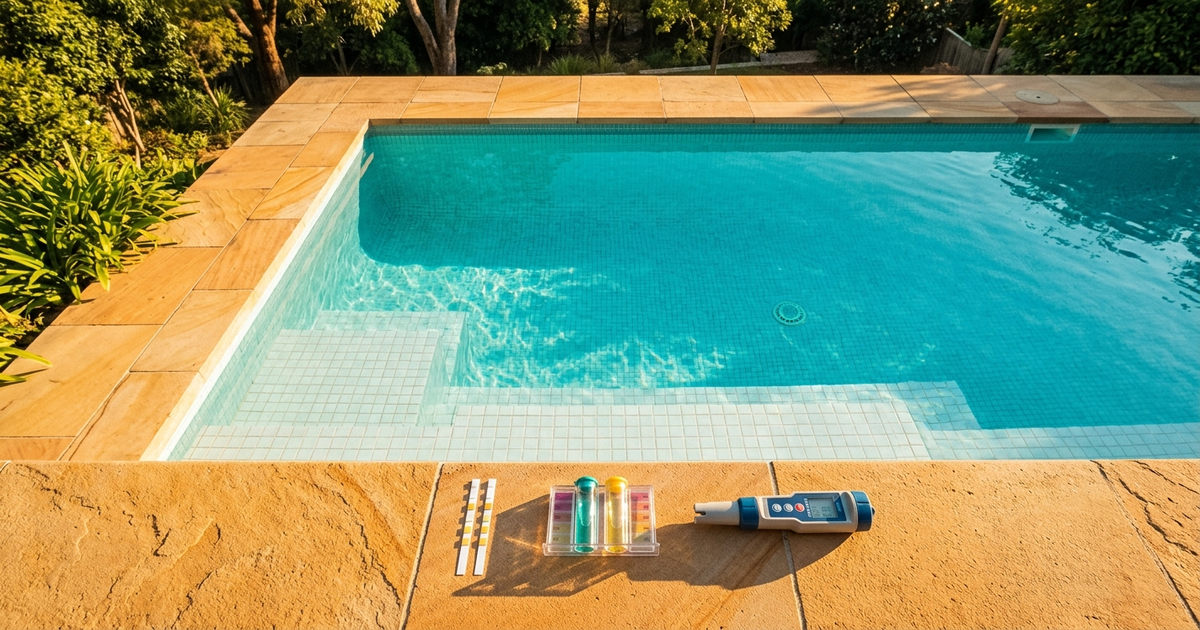
Pool water testing means measuring six things (free chlorine, combined chlorine, pH, total alkalinity, cyanuric acid, and calcium hardness) and a strip dipped in the shallow end is the least accurate way to do it. A drop-based reagent kit reads within 5 to 10 percent on every test; strips give you a color band that can be off by 30 to 50 ppm on alkalinity and CYA even when the bottle is fresh. The order matters too: test pH and chlorine two to three times a week, alkalinity weekly, CYA and calcium hardness monthly.
Use strips for daily quick-checks of free chlorine and pH. Use a drop-based reagent kit for any week where you plan to add chemicals; strip readings can be off by 30 to 50 ppm on alkalinity and CYA.
Most of the time a pool owner spends fighting cloudy water, short chlorine life, or a stubbornly high pH is not a measurement problem. It is a testing problem. If the test number is wrong, every chemical added after it is guesswork. This is the testing routine I worked out across six seasons of running my own pool, and it covers the kit choice, the procedure, the targets, and what to do once the numbers are on paper.
Test Strips Versus Drop Kits Versus Digital
There are three ways to test pool water at home, and they are not interchangeable.
| Method | Typical Accuracy | Cost per Test | Best For |
|---|---|---|---|
| Test strips | ±20% on chlorine; color-band on pH | $0.10 to $0.25 | Daily quick-checks of FC and pH |
| Drop-based reagent kit (FAS-DPD, titration, OTO) | ±5 to 10% | $0.25 to $0.50 | Weekly full panel; dose calculations |
| Digital photometer (Taylor ColorQ, LaMotte WaterLink) | ±5% | $0.40 to $0.80 | Color-blind users; digital readout preference |
| Pool store mail-in or in-store | ±5 to 15% (sample handling varies) | Free with purchase | Once-a-season verification |
Strips fail two ways. First, they read by color matching, and the human eye is unreliable in changing light: the same strip looks one color at 10 a.m. on the deck and a different color at 4 p.m. in the kitchen. Second, the reagent pads degrade fast once the bottle is opened. A bottle of strips left poolside in 95°F heat and humidity will read low on chlorine within 60 days. A drop-based kit stored in shade gives the same reading at month 12 as it did on day one, provided you replace the reagents annually.
For a deeper look at strip technique and the cases where strips are good enough, see the pool test strips guide.
Why Drop-Based Kits Are the Standard
Drop kits like the Taylor K-2006 or LaMotte ColorQ Pro work by titration: you count drops of a known reagent into a measured water sample until a color change happens, then multiply by 10 or 25 to get parts per million. The result is a number, not a color band. You either see the endpoint or you do not; there is no "kind of orange-ish, maybe 5 ppm" ambiguity.
The Taylor K-2006 is the kit I have used since I started maintaining my own pool. It tests free chlorine, combined chlorine, pH, total alkalinity, calcium hardness, and cyanuric acid. The chlorine test uses FAS-DPD titration, which stays accurate down to 0.2 ppm even at high chlorine levels. DPD strips and color-disc kits saturate (bleach out) above 5 ppm of free chlorine and give you a useless gray result exactly when you need a real reading the most (during a SLAM or after shocking).
How to Test Pool Water Step by Step
Test pH and chlorine two to three times a week during swim season. Test alkalinity weekly. Test CYA and calcium hardness monthly. After heavy rain or a pool party, test the next morning.
Testing is step 1, always. The order of operations keeps reagents fresh and avoids cross-contamination between tests.
- Test in shade, never direct sun. Sunlight degrades the DPD and phenol red reagents within minutes. Move to a covered patio, the side of the pool shed, or inside. If you must test in the sun, shade the vial with your body while reading.
- Take the sample from elbow depth, 12 to 18 inches below the surface. Surface water has higher chlorine demand from sun and airborne debris. Hold a clean vial upside down, plunge it to elbow depth, then flip it upright underwater. The pool's circulation has already mixed the bulk water, so a sample from one return jet is the same as one from anywhere else away from the surface.
- Rinse the vial twice with the pool water you are about to test. Any residue from the previous test will skew the next reading by 10 to 30 percent. Rinse, dump, rinse, dump, then fill to the line. This one step changes more first-season results than any other technique.
- Test pH and free chlorine first. Both reagents are the most sensitive to temperature drift and time-since-sample. Do these within 60 seconds of pulling the water.
- Test alkalinity, calcium hardness, and CYA in any order after. These readings are stable; the water sample can sit for 10 minutes without changing the result.
- Read against a white background. Hold the vial against a sheet of paper or the white plastic chip that came with the kit. Match the color to the standard, not the patio tile.
- Record the numbers immediately. Date, time, water temperature, all six readings, plus anything notable (after rain, before shock, after a backwash). Memory is worthless for chemistry trends.
The full procedure takes 6 to 8 minutes once you have done it a few times.
What Each Number Means
A test panel is a snapshot of six independent values, and each one tells you something different about how the water will behave over the next 24 hours.
Free Chlorine (FC)
Free chlorine is the sanitizer available to kill bacteria and algae right now. The target depends on your CYA level, not on a single universal number:
| CYA Level | Minimum FC | Target FC | Shock (SLAM) Level |
|---|---|---|---|
| 30 ppm | 2 ppm | 3 to 5 ppm | 12 ppm |
| 40 ppm | 3 ppm | 4 to 6 ppm | 16 ppm |
| 50 ppm | 4 ppm | 4 to 6 ppm | 20 ppm |
| 70 ppm | 5 ppm | 5 to 8 ppm | 28 ppm |
| 90 ppm (saltwater) | 7 ppm | 7 to 9 ppm | 36 ppm |
The relationship between free chlorine and CYA is the single most misunderstood piece of pool chemistry; see the CYA and chlorine relationship article for the full version. The short version: CYA shields chlorine from sunlight, but it also reduces chlorine's killing strength. A higher CYA reading means you need a proportionally higher FC to keep the same sanitization power.
Combined Chlorine (CC)
Combined chlorine is chlorine bonded to ammonia and other nitrogen compounds, the chemical fingerprint of chlorine that has reacted with bather waste or organics but has not been broken down further. Target is below 0.5 ppm. Anything above 0.5 ppm means there is an organic load the chlorine cannot keep up with, and you need to raise FC to shock level for your CYA and hold it there until CC drops back to zero.
That combined chlorine reading is also what produces "chlorine smell." The strong indoor-pool aroma people associate with chlorine is actually chloramines. A pool that smells strongly of chlorine is undersanitized, not overdosed.
pH
pH measures how acidic or basic the water is, on a 0 to 14 scale where 7 is neutral. Target is 7.4 to 7.8. Below 7.2, water becomes corrosive and irritates eyes and skin. Above 7.8, chlorine effectiveness drops sharply — at pH 8.0, more than half of the free chlorine in the water is in the weaker hypochlorite ion form, which kills bacteria much more slowly than hypochlorous acid.
pH drifts up over time in most pools, especially saltwater pools where the cell process raises pH as a byproduct. Test pH every time you test chlorine. For correction steps, see pool pH balance.
Total Alkalinity (TA)
Total alkalinity is the water's resistance to pH change, the buffer that keeps pH from swinging on every chemical addition or rainfall. Target is 60 to 80 ppm for liquid-chlorine pools and 70 to 90 ppm for saltwater pools. Pool store advice typically says 80 to 120 ppm, which runs high for residential pools at typical CYA levels and contributes to constant pH rise. The pool alkalinity guide covers the math for bringing TA up or down.
Cyanuric Acid (CYA)
CYA is the chlorine stabilizer that protects free chlorine from UV destruction. Without it, an outdoor pool loses 75 to 90% of its free chlorine within 2 hours of direct sun (per Trouble Free Pool community testing). With 30 to 50 ppm CYA, free chlorine half-life under sun extends to 4 to 6 hours.
Target by chlorine source:
- Liquid chlorine (sodium hypochlorite) or cal-hypo: 30 to 50 ppm CYA
- Saltwater chlorine generator: 60 to 80 ppm CYA
- Trichlor tabs: monitor closely — every 10 ppm of FC added through trichlor also adds 6 ppm of CYA, which can climb into the 100+ ppm range within a single season
The CYA test is the fussiest reagent test in a standard kit. It works by turbidity: you add reagent to a water sample, CYA precipitates out as a fine cloud, and you pour the cloudy water into a small tube with a black dot at the bottom. The point where the dot disappears tells you the CYA reading. Read this test in indirect daylight, looking down into the tube from above, not from the side.
Calcium Hardness (CH)
Calcium hardness measures dissolved calcium. Target is 250 to 400 ppm for plaster pools and 150 to 250 ppm for vinyl and fiberglass. Too low etches plaster and corrodes heaters; too high scales tile lines and salt cells. See pool calcium hardness for the dosing details.
Calcium hardness barely changes week to week if you are using liquid chlorine. Monthly testing is enough unless you are running cal-hypo shock, which adds about 0.7 ppm of calcium for every 1 ppm of FC added.
Target Ranges in One Table
Screenshot this for poolside use.
| Test | Target | Test Frequency | Source |
|---|---|---|---|
| Free chlorine | Depends on CYA (see table above) | 2 to 3 times per week | TFP, PHTA |
| Combined chlorine | Below 0.5 ppm | Weekly | CDC MAHC |
| pH | 7.4 to 7.8 | 2 to 3 times per week | PHTA, NSF/ANSI 50 |
| Total alkalinity | 60 to 90 ppm | Weekly | PHTA, TFP |
| Cyanuric acid | 30 to 50 ppm (60 to 80 for SWG) | Monthly | PHTA, NSF |
| Calcium hardness | 250 to 400 (plaster); 150 to 250 (vinyl, fiberglass) | Monthly | PHTA, CDC MAHC |
The CDC's Model Aquatic Health Code uses wider ranges for commercial pools (pH 7.2 to 7.8, FC 1 to 10 ppm), because public facilities deal with higher and more variable bather load. Residential pools benefit from tighter targets because the margin for error is smaller and the daily monitoring is lighter.
Six Testing Mistakes That Throw Off Results
A good kit produces a wrong reading if any of these are happening:
- Old reagents. Replace the bottles every 12 months whether you have finished them or not. Phenol red oxidizes, DPD powder absorbs moisture, and CYA turbidity reagent loses sensitivity. A two-year-old kit reads low on chlorine and high on pH.
- Testing right after a chlorine dose. Wait 4 hours minimum after liquid chlorine and 24 hours after cal-hypo before testing. The chemical needs a full circulation cycle to distribute.
- Sampling from the skimmer. The skimmer captures debris and surface scum, both of which throw off readings. Sample from elbow depth at the deep end.
- Sun exposure on the vial. Reading a chlorine vial in direct sun bleaches the DPD color within 30 seconds and produces a falsely low result.
- Skipping the rinse. Residue from yesterday's pH test contaminates today's alkalinity test by 10 to 20 ppm.
- Reading at an angle. Color-disc kits and turbidity tests require looking straight down or straight through the standard. An angled view shifts the apparent color one band lighter or darker.
I caught my own kit reading 1.5 ppm low on free chlorine for an entire season once because the DPD powder bottle had absorbed humidity and clumped. New reagents, same pool, same week — FC jumped from 3.0 ppm to 4.5 ppm with no chemical change. After that I replaced reagents every spring whether the bottles were empty or not.
From Test Results to Action
Reading the numbers is half the job. The other half is calculating exactly how much of which chemical to add to hit your target — and that is the step where most pool owners freeze up. The math is not hard, but it is fussy. The right dose depends on your current reading, your target reading, your pool's actual gallons, and the strength and form of the chemical you are using (12.5 percent liquid chlorine versus 10 percent, 31.45 percent muriatic acid versus 14.5 percent).
A worked example: starting FC 1.5 ppm, target FC 5 ppm, 15,000 gallons, 12.5 percent sodium hypochlorite. The dose is about 56 ounces. Add a pH correction (current 7.9, target 7.5) with 31.45 percent muriatic acid: about 20 ounces. The acid will also drop alkalinity by roughly 9 ppm, so retest TA after the pH stabilizes 4 hours later.
If you adjust pH and chlorine once a week and you have memorized the math for your specific pool size, a calculator and a notepad are enough. I did exactly that for two seasons. The pool chemical calculator guide breaks down the math chemical by chemical.
The Poolably app (iOS only) takes a full test panel and outputs the exact dose in ounces or pounds based on your pool volume, surface type, and the strength of the chemical on your shelf — it bridges the gap between reading the numbers and pouring the right amount. For pool owners running a salt cell, dosing multiple chemicals each week, or recovering from an algae bloom, doing this by hand turns into a chore fast.
Storage and Safety
A test kit lives outdoors in pool season, but that does not mean it should sit in the sun. Keep the kit case in shade — under the pool storage bench, in a deck box, or inside the pool shed. High temperatures and UV degrade reagents the same way they degrade chlorine.
When you do start adjusting chemicals based on test results:
- Always add chemical to water, never water to chemical. Pouring water into a measure of dry calcium chloride or acid produces a violent reaction.
- Never mix different pool chemicals. The most dangerous combination is chlorine and any acid — together they release chlorine gas, which is fatal in confined spaces.
- Wear chemical-resistant goggles and gloves when handling any pool chemical, including reagents in concentrated form.
- Store every chemical in its original container, in a cool dry place, with chlorine, acid, and shock products physically separated. Original labels carry the SDS information you need if something goes wrong.
FAQ
What is the best pool water testing kit to buy?
The Taylor K-2006 (or K-2006C with larger reagent bottles for fewer refills) is the standard residential drop-based reagent kit. It tests all six numbers using FAS-DPD titration, which stays accurate at high chlorine levels. Expect $70 to $90 for the kit and $25 to $40 per year for replacement reagents.
Are pool test strips accurate enough?
Strips are accurate enough for daily quick-checks of free chlorine and pH if the bottle is fresh, stored cool and dry, and used within 60 days of opening. They are not accurate enough for calculating chemical doses — strip readings can be off by 30 to 50 ppm on alkalinity and CYA. Use strips between full tests; use a drop kit any week you plan to dose.
How often should I test pool water?
Test free chlorine and pH two to three times a week during swim season, total alkalinity once a week, and CYA and calcium hardness monthly. Test the morning after any heavy rain, pool party, or shock treatment to verify chlorine and pH are back in range.
Why does my chlorine read zero right after I added chlorine?
Two possible causes. Either the chlorine has not yet circulated (give it 4 hours after liquid chlorine and 24 hours after cal-hypo with the pump running), or the pool has chlorine demand from algae, ammonia, or dissolved organics consuming the dose as fast as it goes in. A combined chlorine reading above 0.5 ppm confirms the second case — raise FC to shock level for your CYA and hold it there until CC drops back to zero.
Can I trust pool store testing instead of my own kit?
You can use it as a sanity check once a season, but pool store tests have two problems: the sample sits in a hot car on the drive over (which changes pH and burns off chlorine), and the staff are trained to recommend products. For testing accuracy you control, a drop-based kit at home beats a store sample.
Do I need to test if I just balanced everything yesterday?
It depends on what changed in the last 24 hours. If nothing went into the pool — no swimmers, no rain, no chemicals — and you tested yesterday, a same-day retest will read essentially the same. If you swam, dosed, shocked, or got rain, retest before adding anything. In hot weather with heavy UV, free chlorine alone drops 2 to 5 ppm per day even in a balanced pool, so a same-day FC check is still worth doing.
Frequently Asked Questions
Vlad Kuzin
Pool owner and builder of the Poolably app. I got tired of guessing at chemical doses, so I built a calculator that does the math.