Pool maintenance schedule - daily to monthly
A pool maintenance schedule has five recurring tasks: test free chlorine and pH 2-3 times per week, brush walls weekly, clean the filter when pressure climbs 8-10 psi above baseline, and run seasonal opening/closing checklists. That is the entire program. Online checklists say "test your water regularly" with no numbers, which is why pools go green in July despite the owner following the list.
Test free chlorine and pH 2-3 times per week, total alkalinity weekly, CYA and calcium hardness monthly. This schedule keeps the pool swimmable year-round and catches problems before they turn the water green.
The schedule below tells you what to test, what number triggers action, and how much chemical to add per 10,000 gallons. Always test first, then dose, then retest. The numbers come from the CDC Model Aquatic Health Code, ANSI/APSP/ICC-11, and the well-documented CYA-to-chlorine ratio used by Trouble Free Pool. I have run this schedule on my own 18,000-gallon plaster pool for three seasons.
The full pool maintenance calendar at a glance
Screenshot this table. It is the entire article in one block.
| Frequency | Task | Time | Trigger to act |
|---|---|---|---|
| Daily | Visual check (water clear, no debris piles, skimmer not jammed) | 1 min | Cloudiness, color shift, low water level |
| 2-3x per week | Test free chlorine and pH | 3 min | FC below CYA-adjusted minimum; pH outside 7.2-7.8 |
| Weekly | Test total alkalinity; empty skimmers and pump basket; brush walls, steps, waterline | 20-30 min | TA outside 60-120 ppm |
| Weekly | Vacuum or run robotic cleaner | 30-60 min | Visible debris on floor |
| Weekly | Check filter pressure gauge | 30 sec | 8-10 psi above clean baseline |
| Monthly | Test CYA (cyanuric acid) and calcium hardness; test combined chlorine | 10 min | CYA above 80; CH outside 200-400 ppm; CC above 0.5 ppm |
| Monthly | Clean skimmer weir, inspect O-rings, hose down pump strainer basket | 15 min | Visible wear or leaks |
| Monthly (SWG only) | Inspect salt cell, test salt level | 15 min | Cell scaled or salt outside cell's spec range |
| Quarterly | Lubricate O-rings; check sand or DE media level; inspect bonding wire | 20 min | Dry O-rings, low media |
| Seasonal | Open in spring, close in fall (or year-round prep) | 2-4 hours each | Water temp crosses 60 degrees Fahrenheit |
| Every 3-5 years | Replace sand (sand filter), full media swap (DE), or cartridge replacement | 2 hours | Pressure stays high after backwash |
Sources for the target ranges: CDC MAHC ideal ranges (pH 7.2-7.8, free chlorine 1-4 ppm), ANSI/APSP/ICC-11 (TA 60-180 ppm, CH 200-400 ppm), and the CYA-adjusted free chlorine ratio (FC minimum ≈ 7.5% of CYA, FC target ≈ 10-13% of CYA) from Trouble Free Pool's Pool School.
Daily tasks (1 minute)
Walk past the pool and look at it. That is the daily task.
You are checking three things: is the water clear, is the skimmer free of jammed debris, and is the water level above the skimmer mouth? A skimmer that runs dry pulls air into the pump and can burn out the motor in a day. Water clarity is your earliest warning system: a faint cloudy tint that was not there yesterday almost always means free chlorine has dropped below the minimum for your CYA level.
If something looks off, run a quick free chlorine test. That is the entire daily protocol. You do not need to test daily on a stable pool. Looking at it is enough until something changes.
Weekly tasks (30 minutes)
The weekly visit is where the schedule lives or dies. Skip this for two weeks in summer and you will spend a Saturday fixing a green pool. The order matters: test first, brush and empty baskets while chemicals dissolve, retest at the end.
1. Test water (free chlorine, pH, total alkalinity)
Test before you do anything else. A drop-based reagent kit (Taylor K-2006 is the residential standard) gives you numbers you can dose against. Test strips are fine for the daily check but lose accuracy past 60 days from opening and read alkalinity within 30 to 50 ppm of actual.
| Parameter | Target range | Source |
|---|---|---|
| Free chlorine (chlorine pool, CYA 30-50) | 3-7 ppm | CYA/FC chart |
| Free chlorine (saltwater, CYA 60-80) | 4-8 ppm | CYA/FC chart |
| pH | 7.4-7.6 (acceptable 7.2-7.8) | CDC MAHC |
| Total alkalinity | 80-120 ppm | ANSI/APSP/ICC-11 |
The CYA-adjusted free chlorine ranges matter more than the generic "1 to 4 ppm" range printed on test strips. At CYA 80, a free chlorine reading of 2 ppm is functionally undersanitized even though the strip says "ideal." This is the single biggest reason chlorine-stable-looking pools turn green. The relationship between CYA and chlorine is the chemistry every pool owner has to understand.
The CYA-to-chlorine ratio is the single most important pool chemistry concept. At CYA 80, a free chlorine reading of 2 ppm is functionally undersanitized, and you need 4-8 ppm. The generic "1-4 ppm" printed on test strips ignores CYA entirely.
2. Empty skimmer baskets and pump strainer basket
Pull both baskets and dump them. A full skimmer basket cuts flow to the pump by 30 to 50 percent, which drops filtration enough to let fine particles stay suspended for days. This is a 60-second task that has more impact on water clarity than any chemical.
3. Brush walls, steps, and waterline
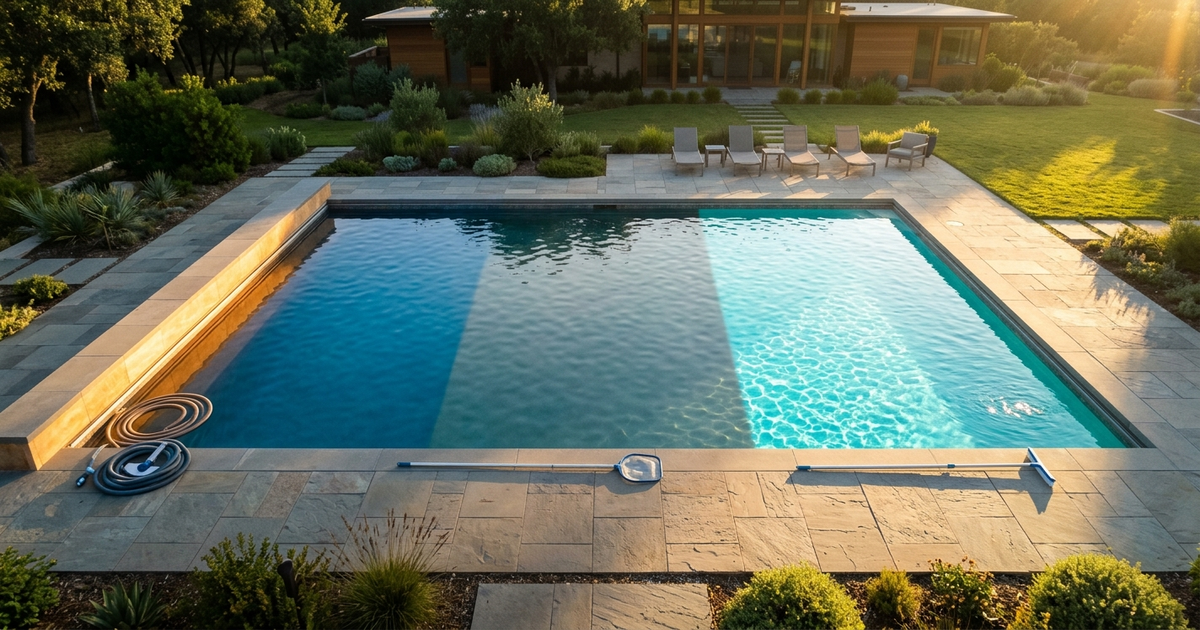
Use an 18-inch nylon brush on a telescoping pole. Brush all walls, steps, swim-outs, behind ladders, and the waterline tile or vinyl band. Total time on an average pool: 5 to 10 minutes.
Brushing dislodges the early algae film before it becomes visible. On plaster pools it also prevents the gray-green stain that sets in around shaded edges. Skip this for a month on a pool with high bather load and you will hand-scrub for an hour to remove what a weekly brush would have prevented.
4. Vacuum or run robotic cleaner
If your robot runs daily on a timer, this is already done. Otherwise, manual-vacuum once a week. Set the multi-port valve to "waste" when vacuuming up algae or fine silt, because that bypasses the filter entirely and saves a backwash.
5. Check filter pressure
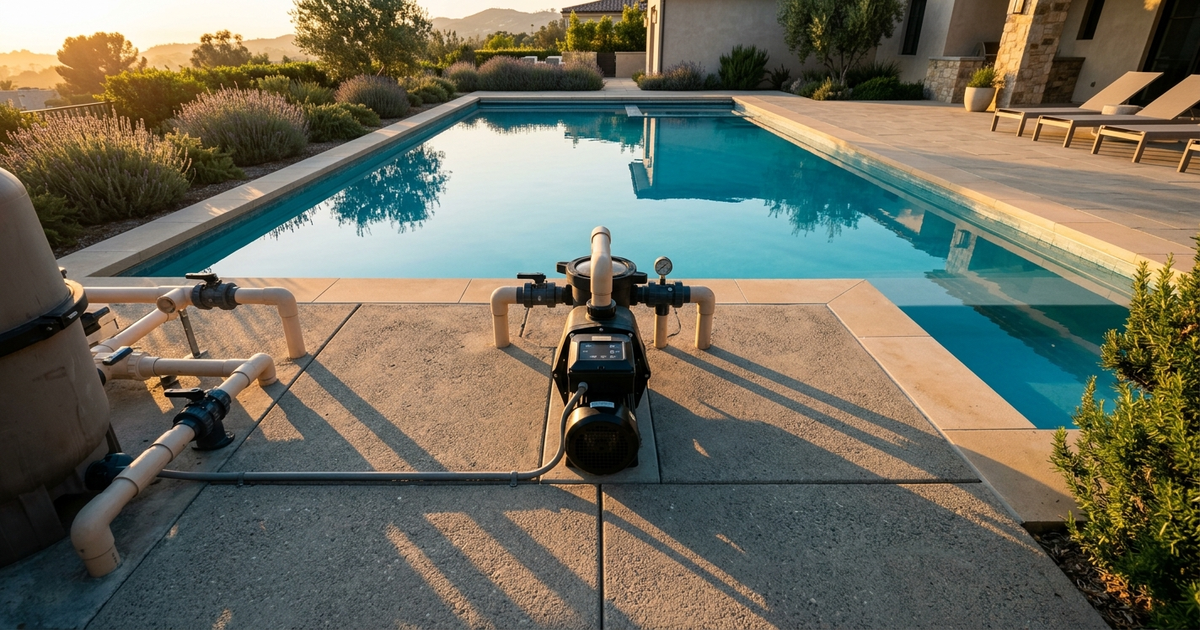
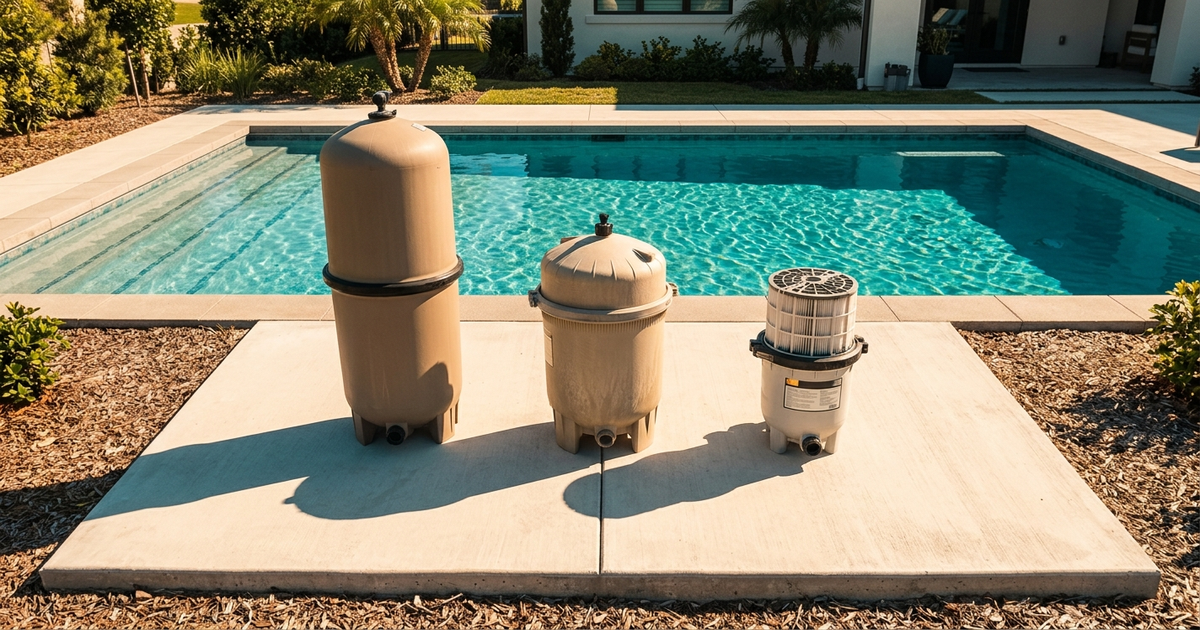
Look at the pressure gauge on the filter. Write down the reading when the filter is freshly cleaned — that is your baseline. Clean the filter (backwash for sand or DE, hose-clean for cartridge) when the gauge reads 8 to 10 psi above that baseline. Cleaning sooner wastes water; later drops flow and leaves debris suspended. The pool filter cleaning deep-dive covers the right cleaning method for each filter type.
6. Add chemicals based on test results
Now dose. The amounts below assume a 10,000-gallon pool, so multiply for your actual volume. For odd volumes or partial doses, the pool chemical calculator guide does the math.
| Problem | Chemical | Dose per 10,000 gallons | Wait before retest |
|---|---|---|---|
| Raise FC by 1 ppm | 10% liquid chlorine | 11 oz | 30 min |
| Raise FC by 1 ppm | Calcium hypochlorite (68%) | 1.6 oz | 4 hours |
| Lower pH from 7.8 to 7.4 | 31.45% muriatic acid | 12-16 oz | 4 hours |
| Raise pH from 7.0 to 7.4 | Soda ash (sodium carbonate) | 6 oz | 1 hour |
| Raise TA by 10 ppm | Baking soda (sodium bicarbonate) | 24 oz | 6 hours |
| Lower TA by 10 ppm | 31.45% muriatic acid, aerated | 25 oz | 12-24 hours |
| Raise CH by 10 ppm | Calcium chloride (77% anhydrous) | 16 oz | 4 hours |
| Raise CYA by 10 ppm | Cyanuric acid (granular) | 13 oz | 5-7 days |
Sources for these dosages: chemical density and 10,000-gallon water mass arithmetic, cross-checked against the Pool Calculator and Trouble Free Pool dose charts.
Safety, every single time: never mix two pool chemicals, because combining chlorine and acid releases chlorine gas, which is what sends people to the emergency room. Always add chemical to water (a small slow stream into the pool's return-jet flow), never water to a bucket of chemical. Wear chemical-resistant goggles and gloves whenever you handle muriatic acid, calcium hypochlorite, or granular shock. Store every chemical in its original sealed container, in a cool dry place, on separate shelves — never stacked.
Monthly tasks (1 hour)
The weekly schedule keeps the pool clear. The monthly schedule keeps the chemistry trending in the right direction.
Test CYA and calcium hardness
CYA changes slowly but only in one direction without intervention: up, from every trichlor tablet you use. A pool running 3-inch tablets in a chlorinator climbs roughly 5 ppm of CYA per pound of tablets dissolved. After three months of summer tablet use, CYA can drift from 40 to 90 ppm — and at 90, you need a free chlorine reading of 7 ppm just to maintain sanitation. Test monthly and switch to liquid chlorine when CYA crosses 60.
Calcium hardness drifts in both directions. Plaster pools leach calcium over time (CH goes up); vinyl and fiberglass pools rarely move without splash-out and refill (CH stays flat or drifts with source water). Action thresholds:
- CH below 150 ppm: water is hungry for calcium and will etch plaster — add calcium chloride.
- CH above 400 ppm: scale risk on the heater and salt cell — partial drain and refill with lower-CH source water is the only real fix.
Test combined chlorine
Combined chlorine (CC) is the chloramines reading on a Taylor or comparable kit. CC above 0.5 ppm means the pool is undersanitized and producing the harsh "chlorine smell" that people blame on too much chlorine. The fix is the opposite: raise free chlorine to shock level for your CYA (typically 10 to 15 ppm) and hold it there until CC reads zero. This is also when you do a deliberate shock, not on a calendar schedule.
Inspect skimmer weir and pump O-rings
Pull the floating weir flap in each skimmer and check for cracks. Open the pump lid and inspect the lid O-ring — if it is flat, cracked, or shiny instead of matte, replace it. A dry or worn pump O-ring lets air into the suction side, which causes priming problems and reduces flow.
Saltwater pool only: inspect the cell
Disconnect power, remove the cell, and look through it toward a light. White scale on the plates means it needs an acid bath — soak in a 4:1 water-to-muriatic-acid solution for 10 to 15 minutes, then rinse thoroughly. A cell with even light scale produces less chlorine than the controller thinks, which is the saltwater equivalent of running out of tablets without noticing.
Seasonal tasks
Two events anchor the year: opening (water temp climbs above 60 degrees Fahrenheit, typically March-April) and closing (water temp drops below 60 degrees, typically October-November).
Spring opening
The compressed version: remove the cover, top off water level, reassemble the pump and filter, run circulation for 24 hours, then test and balance everything from scratch. Free chlorine first (raise to shock level), then alkalinity, then pH, then CYA. The full sequence and what to do when you uncover a swamp is in the pool opening checklist.
Fall closing
The compressed version: balance water to slightly high alkalinity (100-120 ppm) and pH (7.6), raise free chlorine to shock level, lower water below skimmers, blow lines clear, add winter pill or polyquat algaecide, install cover. Closing a pool with low alkalinity or low free chlorine is how spring openings turn into algae-fighting projects. The pool closing checklist walks through line blowing and antifreeze in detail.
Quarterly: lubricate O-rings, check media
Once a quarter, regardless of season:
- Lubricate every visible O-ring (pump lid, filter, automatic cleaner connections) with silicone-based pool lubricant, never petroleum jelly.
- Check sand level on a sand filter (should be at the manufacturer's fill line — typically 6 inches below the top); check DE manifold fingers for cracks.
- Inspect the bonding wire that grounds the pump and any metal equipment. A corroded bond is a real electrocution risk.
Saltwater pool schedule: what changes
A salt chlorine generator (SWG) does not eliminate maintenance — it changes which chemicals you carry. Compared to a traditional chlorine pool:
| Task | Chlorine pool | Saltwater pool |
|---|---|---|
| Daily chlorine source | Tablet feeder or liquid bleach | Cell generates as pump runs |
| Weekly FC test target | 3-7 ppm (CYA 30-50) | 4-8 ppm (CYA 60-80) |
| Weekly chlorine dosing | Add 10% liquid as needed | Adjust SWG output percentage |
| Monthly CYA testing | Critical — climbs from tablets | Critical — protects cell output from UV |
| Monthly cell inspection | n/a | Check for scale, salt level, cell light |
| Salt level | n/a | Test monthly, target per cell spec (typically 3,000-3,500 ppm) |
| pH drift | Down (from acidic tablets) | Up (from SWG operation) |
| Acid usage | Less frequent | More frequent — pH climbs about 0.2 per week on average |
The pH-creep on salt pools is the biggest schedule change. Plan on adding muriatic acid every 1 to 2 weeks instead of every 4. The saltwater pool guide covers cell sizing, salt level, and the rest of the system-specific details.
What happens when you skip a task
This is the troubleshooting flowchart in reverse: each skipped task maps to a specific failure mode.
| Skipped task | What goes wrong | How soon |
|---|---|---|
| Weekly free chlorine test | Pool turns green | 3-7 days in summer |
| Weekly brush | Algae film thickens on plaster, becomes scrubbing job | 2-4 weeks |
| Weekly skimmer empty | Pump loses prime or runs dry, motor risk | 1-2 weeks if leaves are heavy |
| Weekly filter pressure check | Filter clogs, flow drops to near zero, water clouds | 2-6 weeks |
| Monthly CYA test | Chlorine becomes ineffective at "normal" levels | 2-4 months |
| Monthly CH test | Plaster etches (low CH) or scale forms on heater (high CH) | 3-6 months |
| Monthly combined chlorine test | Chloramine buildup, eye irritation, harsh smell | 1-2 months |
| Quarterly O-ring lube | Pump or filter leak, air in suction line | 6-12 months |
| Seasonal closing | Spring opens to a swamp instead of a balanced pool | Next spring |
Skipping the weekly free chlorine test is the number one cause of green pools. It is also the cheapest task on the schedule — three minutes, no materials beyond the test kit you already own. I have skipped it once during a busy week and spent a Saturday recovering. Once was enough.
Tools you actually need
A working maintenance kit, not a pool-store shopping list:
- Drop-based reagent kit (Taylor K-2006 or equivalent)
- Test strips for daily quick-checks
- 18-inch nylon brush head
- Telescoping pole (8-16 ft)
- Leaf rake (deeper bag than a skimmer net)
- Manual vacuum head and hose, OR a robotic cleaner
- Chemical-resistant goggles and gloves
- Notebook or app to log readings
The notebook part matters more than it sounds. CYA and CH drift over months, so a record of "I tested CYA on May 3 and it was 45" tells you something you cannot learn from a single test. The Poolably app's history tab logs every reading with the date, so the testing frequency for the schedule above is visible at a glance — when the gap between two free chlorine entries climbs past 4 days, you can see it. The app also calculates doses from your current readings, so the math in the dosage tables above happens automatically against your actual pool volume. iOS only. If you adjust pH once a month and never touch anything else, a notebook and the table above is enough — the app earns its keep when you are running an active schedule and want the math handled.
FAQ
How often should I test my pool water? Test free chlorine and pH two to three times per week during swim season, total alkalinity weekly, and CYA and calcium hardness monthly. After heavy rain, a pool party, or a shock dose, test the next morning to confirm chlorine and pH are back in range. In winter on a pool that stays open, cut testing to once a week.
How long can a pool go without chlorine before it turns green? In summer water above 80 degrees Fahrenheit, free chlorine can drop from 3 ppm to zero in 48 to 72 hours under direct sun, and visible algae follow within another 24 hours. Skipping the weekly chlorine test is the single most common cause of pools turning green between Friday and Monday. If you are gone more than three days, raise free chlorine to the high end of your CYA-adjusted range before you leave.
Do I really need to brush my pool every week? Yes, even pools that look clean. Algae start as a film on the plaster long before you can see them, especially on shaded steps, behind ladders, and along the waterline. A two-minute brush once a week dislodges the film so free chlorine can kill it in open water. Skip brushing for a month and you will hand-scrub for an hour to remove what brushing would have prevented.
Is a saltwater pool less maintenance than a chlorine pool? Slightly. You no longer carry chlorine jugs, but you still test the same parameters plus salt level and cell condition. Saltwater pools also need higher CYA (60 to 80 ppm versus 30 to 50 ppm for chlorine pools) and a monthly cell inspection. Real time savings is about 10 minutes per week, not the hours that salt system marketing implies.
How often should I shock my pool? There is no fixed schedule. Shock when combined chlorine reads above 0.5 ppm, after heavy bather load (more than 10 swimmer-hours), after heavy rain that drops free chlorine to zero, or when you see early algae. A pool with stable chemistry and light use can go a full season without a deliberate shock. A pool with kids, dogs, or storms may need it every two weeks.
What happens if I skip the monthly CYA test? CYA only goes up (from stabilized tablets) or down (from water replacement and splash-out), so over months it drifts far from where you assume it is. If CYA climbs to 100 ppm without you noticing, the free chlorine needed to actually sanitize the pool roughly doubles, and your test strips will read "normal" while algae bloom anyway. The monthly CYA check is what keeps the chlorine you add doing the work you expect.
The bottom line: the schedule above is what works on a real pool, not a pool-store fantasy. Print the master table, stick it on the inside of the equipment-shed door, and follow it for one season. After that, you will know your pool well enough to adjust.
Frequently Asked Questions
Vlad Kuzin
Pool owner and builder of the Poolably app. I got tired of guessing at chemical doses, so I built a calculator that does the math.