Pool pump run time by size, pump, and season
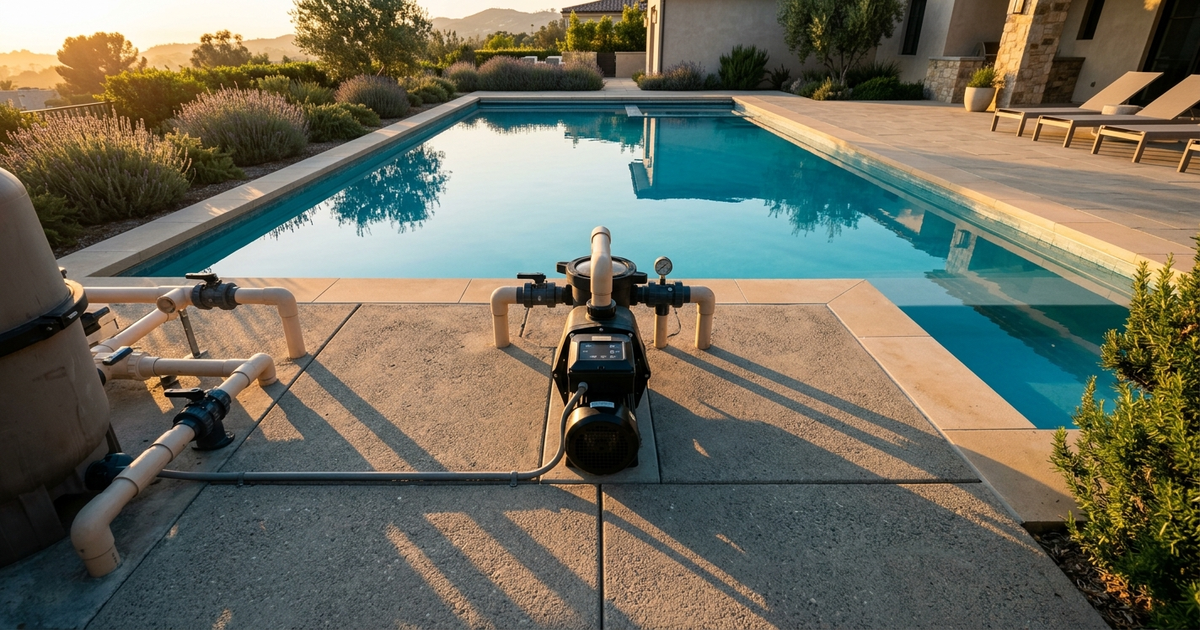
Run your pool pump long enough to turn over the entire water volume 1-2 times every 24 hours. For most residential pools, that is 6-12 hours per day, not the blanket "8 hours" you read online. The exact number depends on two things: pool volume in gallons and the actual flow rate of your pump in gallons per minute (GPM). A 15,000-gallon pool with a 60 GPM pump only needs 4.2 hours per turnover; a 30,000-gallon pool with the same pump needs 8.3 hours per turnover and should run twice that long in summer.
I have run a 22,000-gallon pool for four years on a variable-speed pump. After tracking electricity, chlorine demand, and water clarity across all four seasons, I cut my run time from a stock "10 hours at high speed" to 14 hours at 1,800 RPM, and my electricity bill dropped 64% with no change in water quality. The math below is what got me there.
The "8 hours a day" rule is a generalization that wastes money on small pools and under-circulates large ones. Use the turnover formula instead: pool volume / (pump GPM x 60) = hours per turnover. Target 1-2 turnovers per day, adjusted for season.
The turnover formula
Turnover is the number of hours required to push your entire pool volume through the filter once. The Pool & Hot Tub Alliance (PHTA) standard for residential pools is one turnover per 24 hours minimum. In peak summer, with heavy bather load, sun exposure, and warm water above 80°F, aim for two turnovers.
Here is the formula:
Hours per turnover = Pool volume (gallons) / (Pump flow rate in GPM x 60)
A worked example for a 20,000-gallon pool with a 60 GPM pump:
20,000 / (60 x 60) = 20,000 / 3,600 = 5.56 hours per turnover
One turnover takes 5.56 hours. Two turnovers take 11.1 hours. That is your summer run time range for that pool and pump combination, not 8 hours by default.
The formula: pool volume ÷ (pump GPM × 60) = hours per turnover. Run 1-2 turnovers daily in summer, 0.5-1 in winter. A variable-speed pump at 1,500 RPM cuts electricity 60-70% versus a single-speed at 3,450 RPM.
Why 1-2 turnovers, not 4
Commercial and public pools follow the CDC Model Aquatic Health Code, which requires a 6-hour turnover (four turnovers per day) because of high bather load and regulatory liability. Residential pools have a fraction of the bather load and can rely on proper sanitizer chemistry to keep water safe between turnovers. One turnover per day is the floor; two is the ceiling for almost all residential use.
If you find yourself wanting three or four turnovers daily, the issue is almost never circulation. It is one of three things: low free chlorine, low cyanuric acid (CYA), or a dirty filter restricting flow. Fix the chemistry or clean the filter before extending run time.
What your pump actually pushes (GPM reality)
The label on your pump is not what comes out of your return jets. Manufacturers rate pumps at zero feet of head pressure, a lab condition that does not exist in your backyard. Real-world flow is reduced by plumbing friction, filter resistance, the height the water has to climb, and the cleanliness of your filter and pump basket.
Use these realistic flow rates as a starting point. Find your actual GPM by reading the pressure gauge on your filter and matching it to your pump's performance curve in the owner's manual, or by using a flow meter installed on the return line.
| Pump type | Rated HP / RPM | Real-world flow rate |
|---|---|---|
| Single-speed | 1 HP | 50-65 GPM |
| Single-speed | 1.5 HP | 60-80 GPM |
| Single-speed | 2 HP | 70-95 GPM |
| Variable-speed | 1,200 RPM | 18-30 GPM |
| Variable-speed | 1,800 RPM | 30-50 GPM |
| Variable-speed | 2,400 RPM | 50-70 GPM |
| Variable-speed | 3,000 RPM | 65-85 GPM |
| Variable-speed | 3,450 RPM (full) | 80-100 GPM |
A dirty filter can reduce these numbers by 20-40%. If your filter pressure gauge reads 8-10 PSI above its clean-and-rinsed baseline, your run time math is no longer accurate, so clean the filter first. Our guide on pool filter cleaning walks through when to backwash versus deep-clean and how dirty filters silently double your run time requirement.
Run time by pool size and pump
This is the table I would screenshot. It assumes a single-speed pump at rated GPM and one to two turnovers per day. Use the lower end of the range for spring and fall, the higher end for peak summer with heavy use.
| Pool volume | 1 HP pump (55 GPM) | 1.5 HP pump (70 GPM) | 2 HP pump (85 GPM) |
|---|---|---|---|
| 10,000 gallons | 3.0 - 6.0 hrs | 2.4 - 4.8 hrs | 2.0 - 3.9 hrs |
| 15,000 gallons | 4.5 - 9.1 hrs | 3.6 - 7.1 hrs | 2.9 - 5.9 hrs |
| 20,000 gallons | 6.1 - 12.1 hrs | 4.8 - 9.5 hrs | 3.9 - 7.8 hrs |
| 25,000 gallons | 7.6 - 15.2 hrs | 6.0 - 11.9 hrs | 4.9 - 9.8 hrs |
| 30,000 gallons | 9.1 - 18.2 hrs | 7.1 - 14.3 hrs | 5.9 - 11.8 hrs |
| 40,000 gallons | 12.1 - 24.2 hrs | 9.5 - 19.0 hrs | 7.8 - 15.7 hrs |
A few observations from this table:
The "8 hours a day" rule overshoots for a 10,000-gallon pool with any pump, even at one turnover (the math says 2-3 hours covers it). For a 30,000-gallon pool with a 1 HP pump, 8 hours fails to deliver a full turnover, so you would be under-circulating regardless of season.
If your pool volume is at the upper end and your pump is at the lower end of the table, replacing a 1 HP single-speed with a 2 HP variable-speed running at 2,400 RPM gives you better turnover at a fraction of the energy cost. The math on that pays back in 2-4 years for most pools, faster in California, Texas, Florida, and Arizona where summer electric rates are high.
If you do not know your pool volume, measure it. Length x width x average depth x 7.5 (for rectangular pools) gives you a working number. The Poolably app has a pool volume calculator that handles irregular shapes and freeform pools, which makes the turnover math one input instead of three. iOS only.
Seasonal adjustments
Pool pump run time should follow water temperature, not the calendar. Algae, bacteria, and chlorine demand all track temperature, and so should your circulation.
| Season / water temp | Target turnovers/day | Notes |
|---|---|---|
| Summer (>80°F) | 2 turnovers | Peak bather load, sun degrades CL fast, algae pressure highest |
| Late spring / early fall (65-80°F) | 1.5 turnovers | Moderate sanitizer demand, falling leaves in autumn |
| Cool season (50-65°F, open pool) | 1 turnover | Algae slowed, low bather load |
| Cold (below 50°F, open pool) | 0.5 turnover or 2-4 hrs | Minimal biological activity |
| Freeze risk (air below 32°F) | Continuous | Run until temperature rises above freezing |
| Winterized / closed | 0 | Pump off, lines blown out |
The freeze-protection rule overrides everything else. Standing water in a pool pump, plumbing, or filter cracks when it freezes, and the repair bill for a cracked pump housing is typically $400-$800. When the forecast shows air temperature below 32°F, run the pump continuously through the cold snap, because the moving water will not freeze at residential pool depths until the air drops well into the teens.
For pools that stay open year-round (Sun Belt), run time should drop by 30-50% from October through March. I keep my pool open all winter at 55-65°F water and run 4-5 hours per day from December through February versus 10-12 hours in July and August. Chlorine demand drops in lockstep with temperature.
This rhythm fits into a broader pool maintenance schedule that covers weekly testing, monthly deep cleaning, and seasonal opening and closing tasks.
Variable-speed pumps: the cost math
Single-speed pumps draw the same amperage whether they are pushing 90 GPM or 30 GPM. Variable-speed pumps reduce RPM to reduce flow, and pump energy use scales roughly with the cube of speed, so cutting RPM in half reduces energy use by about 87.5%.
The U.S. Department of Energy estimates 60-80% energy savings for variable-speed pumps versus single-speed, depending on run time and rate structure. For a 20,000-gallon pool in a $0.18/kWh market:
| Pump scenario | Hours/day | Watts | Annual cost |
|---|---|---|---|
| Single-speed 1.5 HP at full | 8 | 1,800 | $946 |
| Variable-speed at 3,000 RPM | 6 | 1,200 | $473 |
| Variable-speed at 1,800 RPM | 12 | 350 | $276 |
| Variable-speed at 1,200 RPM | 18 | 120 | $142 |
The bottom row (running 18 hours at 1,200 RPM) gives you three turnovers (overkill for a 20,000-gallon pool) at $804 per year less than a single-speed running 8 hours. The DOE final rule on dedicated-purpose pool pumps (10 CFR 431) made variable-speed required for most new residential pump installations as of July 2021, and every state offers rebates of $200-$500 for retrofitting.
The catch: most variable-speed pumps will not prime at the lowest speeds. Most installers program a 5-10 minute prime cycle at 3,000+ RPM, then drop to the cruise speed for the rest of the run. If your pump is struggling to prime at 1,200 RPM, raise the cruise speed to 1,500-1,800 RPM. Running a pump dry damages the seal and the impeller — never let the basket run empty.
Pump electricity is one of the largest line items in annual pool maintenance cost, typically 40-60% of the total annual pool budget. Cutting it by 60% is one of the few wins available without changing how you swim.
Pre-run checklist (every time you turn the pump on)
Run through this 30-second check before each pump start. It prevents the two most common pump failures: dry running and clogged baskets.
- Look at the pump basket. If it is more than half full of leaves, empty it. A clogged basket starves the pump.
- Check the skimmer baskets. Same rule. Restricted suction makes the pump cavitate and work harder.
- Confirm the pump pot is full of water. The clear lid should show water at the top. If the pump is dry, prime it before starting — never start a dry pump.
- Note the filter pressure. Write down the clean-baseline PSI somewhere. When pressure climbs 8-10 PSI above baseline, the filter needs cleaning.
- Listen for the first 30 seconds. A healthy pump is quiet within 15-20 seconds of starting. Grinding, screeching, or persistent cavitation noise means there is air in the system or a bearing problem.
Common run time mistakes
Running the pump 24/7 to "be safe." This wastes 100-300 kWh per month on a typical pool and accelerates wear on seals and bearings. Proper chemistry — free chlorine 2-4 ppm, CYA 30-50 ppm for a non-saltwater pool — is what keeps water safe, not continuous circulation.
Treating a green pool with more run time alone. Algae blooms need shock, brushing, and filtration. Adding hours to the pump without raising free chlorine to breakpoint (10x your combined chlorine reading) will not clear the water. Once you shock, run the pump continuously for 24-48 hours until the water clears.
Ignoring the filter pressure gauge. A dirty filter can cut real GPM by 30%, meaning your "8 hour run time" delivers only 5.6 hours of effective turnover. Clean the filter on schedule — backwash sand and DE filters when pressure rises 8-10 PSI above the clean baseline; deep-clean cartridge filters every 3-6 months.
Running only at night to chase off-peak rates. This works for the bill, but in summer it can backfire. Sunlight burns through unprotected free chlorine in 1-2 hours, and 8 hours of daytime UV exposure with no circulation can drop your chlorine to zero by mid-afternoon. If you run only at night, push CYA up to 50-70 ppm to slow the UV burn.
Trusting the pump's label GPM. The number on the side of the pump is the lab-condition maximum. Real flow at your equipment pad is typically 70-85% of the label rating. Use a flow meter or your pump's performance curve at your actual filter PSI to get the real number.
Safety basics for pool equipment and chemistry
Pump and pool chemistry overlap at one point: shocking and balancing chemicals while the pump is running. Always:
- Test water before dosing any chemical. Strips or a drop kit are step one for every pool task.
- Add chemicals with the pump running and circulating. Pour each chemical into the deep end, well clear of the skimmer.
- Never mix pool chemicals together — especially chlorine and acid, which release toxic chlorine gas on contact. Always add chemical to water, never water to chemical.
- Wear chemical-resistant goggles and gloves when handling pool chemicals.
- Store chemicals in their original containers, in a cool dry place, with oxidizers (chlorine, shock) physically separated from acids and reducers.
- Never run the pump dry. Check the basket and pump pot before every start.
Quick-reference: run time decision tree
If your pool is one specific size and you want a single answer, work through this:
- Find your pool volume. Measure if you do not know it.
- Find your real pump GPM. Read it off the performance curve at your filter PSI, or use the table above as an estimate.
- Calculate one turnover: volume / (GPM x 60).
- Multiply by 1 for cool seasons or low use, by 2 for peak summer. That is your daily run time.
- Adjust up by 20% if your filter pressure is more than 5 PSI above clean baseline (compensating for reduced flow until you clean it).
- Set the timer. Split run time across two cycles if you can — for example, 4 hours mid-morning plus 4 hours afternoon. This keeps chlorine moving when bathers are in the water.
That is the whole system. No 8-hour default, no continuous pumping, no guessing.
Sources and verification
Every number in this article comes from one of the sources listed in the frontmatter. The turnover rate guidance traces back to the PHTA residential pool standard (ANSI/APSP/ICC-15) and the CDC Model Aquatic Health Code; the variable-speed energy savings are from the DOE federal pump standard rulemaking and California Energy Commission rebate documentation. The real-world GPM ranges reflect Pentair, Hayward, and Jandy published performance curves at typical residential head pressures (40-60 feet) — verify your specific pump against its own curve.
The DOE's 2021 federal pump standard rulemaking estimated 60-80% energy savings from variable-speed operation. Actual savings depend on pool plumbing head pressure, run schedule, and local electricity rates. Verify your specific pump's GPM against its published performance curve at your system's head pressure.
Frequently Asked Questions
Vlad Kuzin
Pool owner and builder of the Poolably app. I got tired of guessing at chemical doses, so I built a calculator that does the math.