Above ground pool maintenance - what is different
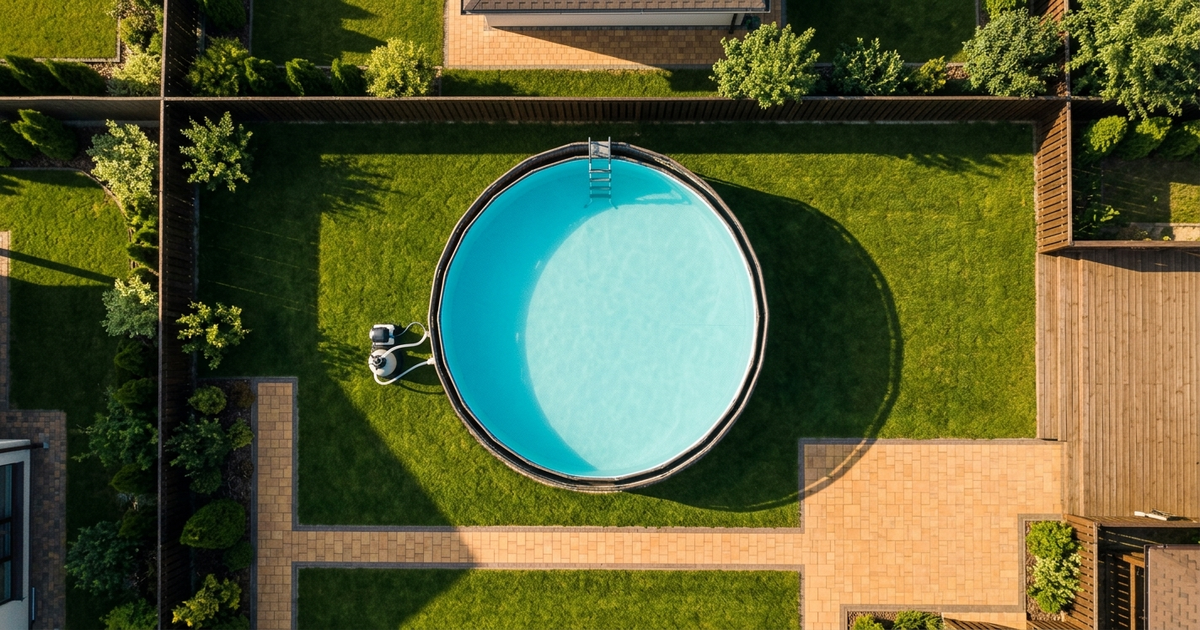
Above ground pools use the same chemistry as in-ground pools, but the equipment, the structural rules, and the way chemicals behave are different enough that following in-ground advice will damage the liner, swing the pH, or collapse the wall. The biggest practical differences are smaller water volume (chemicals act faster and stronger), a vinyl liner instead of plaster (no calcium chloride dumped straight in), undersized pumps and filters that need longer run times, and the rule that you never fully drain the pool.
Same chemistry targets as in-ground: free chlorine 3-7 ppm at CYA 30-50, pH 7.4-7.6, alkalinity 80-120 ppm, calcium hardness 150-250 ppm (lower end for vinyl). Different equipment, different liner care, different winterization, and a hard rule against fully draining the pool.
Never fully drain an above ground pool. The water weight holds the liner against the wall and resists frost heave. Draining collapses the wall, voids the liner warranty, and costs $500-$1,500 to reset.
I have run an 18-foot round above ground pool (around 7,500 gallons) for two seasons alongside a larger in-ground, and the maintenance habits transfer maybe 60 percent. The dosing math is the same; everything else needs a small adjustment. Below is what actually changes, with dosages keyed to typical above ground volumes.
Volume changes everything (and most articles ignore this)
The single biggest practical difference is that above ground pools hold a lot less water than in-ground. The chemistry ranges are identical, but a dose that nudges an in-ground pool can overshoot a smaller above ground pool by a wide margin.
Typical above ground volumes (steel-wall round and oval pools, manufacturer specs from Intex, Coleman, Bestway, and traditional Doughboy-style pools):
| Pool size | Wall height | Approximate gallons |
|---|---|---|
| 15 ft round | 48 in | 4,400 |
| 15 ft round | 52 in | 4,800 |
| 18 ft round | 52 in | 7,500 |
| 21 ft round | 52 in | 10,400 |
| 24 ft round | 52 in | 13,500 |
| 27 ft round | 52 in | 17,000 |
| 15 x 30 ft oval | 52 in | 10,500 |
| 18 x 33 ft oval | 52 in | 13,000 |
These numbers come from the standard cylindrical-volume formula (radius squared, times height, times 7.48 gallons per cubic foot), adjusted to roughly 90 percent of theoretical capacity because the water sits below the wall top. The Poolably app's volume calculator includes round and oval above ground shapes - enter the diameter and wall height and it does the gallons math.
Why this matters in practice: a 24-foot round above ground pool holds about 13,500 gallons. A typical in-ground residential pool holds 20,000 to 25,000. Adding the same 1 pound bag of cal-hypo shock raises free chlorine by 7-9 ppm in the in-ground pool and 13-15 ppm in the above ground - and on a vinyl liner, free chlorine above 15 ppm starts bleaching color out of the print pattern. Dosage charts written for "your pool" assume 10,000-25,000 gallons. If you have an above ground, you cannot ignore the volume basis.
The pool chemical calculator guide walks through the math for any volume, but the short version is: weigh the chemical and the water together, do not eyeball it.
Vinyl liner rules: what you cannot dump in
The pool's interior surface is vinyl, not plaster. That changes which chemicals you handle, how you add them, and where you store them.
Three rules that do not apply to in-ground plaster pools but matter on vinyl:
- Never broadcast undissolved cal-hypo or trichlor on the liner. Calcium hypochlorite granules and trichlor tablets sitting on vinyl will bleach a white spot in 15 minutes. Pre-dissolve cal-hypo in a 5-gallon bucket of pool water and pour around the perimeter with the pump running. Use trichlor only in a floater or chlorinator, never on the floor or in a skimmer that drains to a stopped pump.
- Skip calcium chloride unless your hardness is below 150 ppm. Plaster pools leach calcium and need topping up. Vinyl pools do not, and most vinyl owners run fine at 175-225 ppm calcium hardness from source water alone. Dosing calcium "just in case" pushes you toward scale on the heat exchanger if you have a heater, and does nothing for the liner.
- Watch low pH carefully. Below pH 7.2, vinyl plasticizers slowly leach out and the liner gets brittle. In-ground plaster takes the hit too (etching) but the failure mode on vinyl is the liner shrinking and cracking at the bead a few years sooner than it should. If your pH drops below 7.2, raise it before doing anything else.
Vinyl liners do not need calcium for their own protection, but they do need it for any metal in the system - heater elements, light niches, ladder bolts, salt cell plates. Source water with extremely low calcium (under 50 ppm, common in soft-water regions) will pit anodized aluminum ladders within a season. Test source water once when you fill, then test calcium monthly during the season.
Pump and filter sizing: what came in the box is usually undersized
Most above ground pools ship with a pump and filter that meet the legal minimum and nothing else. A 1 HP single-speed pump and a 100 square foot cartridge or a 19-inch sand filter is typical on a 24-foot round (13,500 gallons). That is enough flow if you run it 10-12 hours a day. It is not enough if you only run it 6.
Sizing targets, regardless of pool brand:
| Pool volume | Minimum pump flow (after filter resistance) | Run hours per day | Filter size minimum |
|---|---|---|---|
| 5,000 gal | 11 GPM (640 GPH) | 8 hr | 0.8 sq ft sand / 60 sq ft cartridge |
| 7,500 gal | 16 GPM (940 GPH) | 8 hr | 1.0 sq ft sand / 75 sq ft cartridge |
| 10,000 gal | 21 GPM (1,250 GPH) | 8 hr | 1.2 sq ft sand / 90 sq ft cartridge |
| 13,500 gal | 28 GPM (1,700 GPH) | 8 hr | 1.4 sq ft sand / 100 sq ft cartridge |
| 17,000 gal | 35 GPM (2,100 GPH) | 8 hr | 1.8 sq ft sand / 130 sq ft cartridge |
Source: industry guideline of one full pool turnover in 8 hours, derived from ANSI/APSP/ICC-11 turnover guidance for residential pools.
If you cannot meet the flow target, extend the run time. A 1,000 GPH pump on a 13,500 gallon pool needs 13.5 hours to turn over once, not 8. That is fine if you have time-of-use electricity rates favorable to overnight running; it is expensive if you do not. The fix in that case is a larger pump, not a longer cycle of an undersized one - undersized pumps tend to be single-speed, and single-speed at full RPM is the worst combination of noise and watts.
Sand filter media on small above ground pools is silica sand (replace every 5 years) or zeobrite (replace every 7-10 years, smaller particle capture). Cartridge filters need a hose-down every 4-6 weeks during heavy use and a chemical soak twice a season. The general pool filter cleaning procedure applies, but on a small cartridge the trigger is usually visible debris on the pleats before the pressure climbs.
CYA management is more critical (because the swings are bigger)
In a 25,000 gallon in-ground pool running tablets, cyanuric acid climbs maybe 2-3 ppm per week. In a 7,500 gallon above ground pool with the same tablet load, CYA climbs 8-10 ppm per week. By mid-July you can be at CYA 90 ppm without changing a single habit.
What goes wrong at high CYA: the free chlorine reading you need for actual sanitation rises with CYA. At CYA 30 ppm, 3 ppm of free chlorine kills algae. At CYA 90 ppm, you need 7-8 ppm of free chlorine to do the same work, and test strips will say "ideal" while the algae bloom. This is the single most common reason small above ground pools turn green in August despite a stable tablet schedule.
The fix is to switch chlorine sources mid-season:
- Early season (CYA 30-50): trichlor tablets in a floater or chlorinator. Convenient, adds CYA at a useful rate.
- Mid-season (CYA 50-70): half tablets, half liquid chlorine. Tablets only when you cannot get to the pool for 3+ days.
- Late season (CYA above 70): liquid chlorine only (10-12.5% sodium hypochlorite). Add every 2-3 days based on testing.
- CYA above 90: drain 20-30% of the pool and refill to dilute. There is no chemical that removes CYA from water at residential scale; dilution is the only fix.
The pool stabilizer CYA guide covers the chemistry in more depth, but the practical rule for above ground owners is simple: test CYA every two weeks, not monthly, because the smaller volume drifts faster.
The weekly schedule for an above ground pool
The general pool maintenance schedule applies, with these adjustments for above ground:
| Frequency | Task | Adjustment for above ground |
|---|---|---|
| Daily | Visual check | Same |
| 2-3x per week | Test free chlorine and pH | Same, but smaller volume swings faster after rain |
| Every 2 weeks | Test CYA | More frequent than monthly because tablets concentrate faster in small volumes |
| Weekly | Test alkalinity, brush walls, empty skimmer basket | Brush gently on vinyl - stiff brushes can mark the liner |
| Weekly | Vacuum or run robot | Most pool robots are too heavy for soft-bottom above grounds - use a manual vac head on a pole instead |
| Monthly | Test calcium hardness | Less critical than on plaster, but test to catch source-water changes |
| Monthly | Inspect liner for stretching, wrinkles, bead seating | Unique to above ground - early catch prevents tears |
| Seasonal | Open and close | Different procedure - see below |
The brush head matters more than people think. Wire bristles or hard nylon can leave marks on a vinyl liner. Use a soft nylon brush or a vinyl-rated brush head (most pool stores label them). Brush weekly, not as a chore but to dislodge the algae film before it sets - same logic as plaster, gentler tool.
Dosage table for typical above ground volumes
Test first, dose to your actual reading, retest before adding more. These are the same chemicals as in-ground but scaled to common above ground volumes.
| Adjustment | Chemical | 5,000 gal dose | 7,500 gal dose | 10,000 gal dose | Wait before retest |
|---|---|---|---|---|---|
| Raise FC by 1 ppm | 10% liquid chlorine | 5.5 oz | 8 oz | 11 oz | 30 min |
| Raise FC by 1 ppm | 68% cal-hypo (pre-dissolved) | 0.8 oz | 1.2 oz | 1.6 oz | 4 hr |
| Lower pH from 7.8 to 7.4 | 31.45% muriatic acid | 6-8 oz | 9-12 oz | 12-16 oz | 4 hr |
| Raise pH from 7.0 to 7.4 | Soda ash | 3 oz | 4.5 oz | 6 oz | 1 hr |
| Raise TA by 10 ppm | Baking soda | 12 oz | 18 oz | 24 oz | 6 hr |
| Lower TA by 10 ppm | 31.45% muriatic acid (aerated) | 12 oz | 18-19 oz | 25 oz | 12-24 hr |
| Raise CH by 10 ppm (only if below 150) | Calcium chloride (77%) | 8 oz | 12 oz | 16 oz | 4 hr |
| Raise CYA by 10 ppm | Cyanuric acid (granular) | 6.5 oz | 10 oz | 13 oz | 5-7 days |
Sources: 10,000-gallon dosages from chemical density and water mass arithmetic, cross-checked against Trouble Free Pool's PoolMath and the Pool Calculator. Scaled linearly for smaller volumes.
Safety, every time you handle chemicals: never mix two pool chemicals - combining chlorine and acid releases chlorine gas. Always add chemical to water (slow stream into the return-jet flow), never water to a bucket of chemical. Wear chemical-resistant goggles and gloves for muriatic acid, cal-hypo, and granular shock. Store chemicals in their original sealed containers, in a cool dry place, on separate shelves. On a vinyl pool, never broadcast undissolved cal-hypo or trichlor - pre-dissolve and pour around the perimeter with the pump running.
Winterization: cover, do not drain
The closing rule for an above ground pool is the opposite of the rule most people guess. You do not drain the pool to protect it from ice. Draining causes more damage than leaving water in.
Why you do not drain:
- Wall collapse risk. Steel-wall and resin-wall above ground pools depend on outward water pressure to hold their shape. An empty pool on a windy or sun-warm day can buckle inward in hours. I have seen a 24-foot round pull a 3-foot dent in its wall over a single warm February afternoon when an owner drained it "for the winter."
- Liner shrinkage. Vinyl liners stretch into their installed shape over time. Dry-cold vinyl shrinks and stiffens. A liner emptied in October and refilled in May rarely refits the floor and wall corners cleanly - you get wrinkles, bead pull-out, or a leak.
- Frost heave. Ground around the pool freezes and shifts. Water in the pool stabilizes ground temperature around the perimeter and absorbs lateral pressure from frozen ground.
The right procedure for closing an above ground pool:
- Test and balance to the high end of every range a week before close. Alkalinity 100-120 ppm, pH 7.4-7.6, calcium 200-250 (vinyl) or 250-350 (if you have any metal heat exchanger), free chlorine at your CYA-adjusted minimum.
- Shock to 3x your normal target with liquid chlorine (cal-hypo on a vinyl pool only if you pre-dissolve and watch for bleaching). Run the pump 24 hours.
- Add a winter algaecide - 16 oz of 60% polyquat per 10,000 gallons. Skip pre-packaged "winter kits" - they are the same chemicals at 2-3x the price.
- Lower the water 4-6 inches below the skimmer mouth (for a solid cover) or 12 inches (for a mesh cover). Use a submersible pump or the multi-port valve on "waste." Do not drain below 12 inches under any circumstance.
- Add an air pillow under the cover, inflated to about 60-70 percent. The pillow absorbs the lateral pressure of ice expansion, which would otherwise push out against the wall.
- Disconnect, drain, and store the pump and filter in a frost-free location. Plug return and skimmer with winter plugs or a Gizzmo (a threaded foam plug that absorbs ice expansion). Blow the lines clear if you have any rigid PVC plumbing.
- Cover and secure with a winter cover and a cable winch or cover clips. Set a cover pump or siphon hose on top to clear standing water.
The pool closing checklist covers each step in more detail, but the steps that differ from in-ground are the air pillow, the much lower water-drop limit, and the absolute prohibition on full drain.
Spring opening: cleaner than in-ground but with one trap
Above ground pools open easier than in-ground for one reason: less water for debris to settle into. The trap is that the air pillow needs to come out before you pump water off the cover, or you flip the pillow into the pool along with a winter's worth of dead leaves.
The pool opening checklist walks through the full sequence. The above-ground-specific moves:
- Pump cover water off first, then peel the cover back slowly so debris stays on top. Do not let the cover sag into the water.
- Inspect the wall and liner before you do anything else. Look for dents, rust spots on a steel wall, or stretched bead at the top. Catch these now while the pool is partially drained.
- Top off water to the middle of the skimmer mouth, reconnect pump and filter, then shock and balance. Open with FC first (raise to shock level for your CYA), then pH and alkalinity.
- Run the pump 24-48 hours continuously to clear cloudiness. With a small filter, this takes longer than on in-ground.
Where the Poolably app helps (and where it does not)
A test kit and a notepad work fine for an above ground pool if you do the math by hand. The chemistry is not different from in-ground - just scaled smaller. If you only adjust pH once a month, you can read the pool maintenance schedule numbers and divide by your volume.
Where the math gets tedious is multi-parameter adjustments after a rain or a party - free chlorine down, pH up, alkalinity drifted, and you need to dose three things in the right order without overshooting. The Poolably app's calculator handles above ground shapes (round and oval) in the volume setup, then takes your actual readings and outputs the dose for each chemical scaled to your real gallons. iOS only. Test strips or a drop kit are still step one - the app reads your numbers, it does not measure them.
Sources
Listed in the frontmatter above. The dosage math is derived from chemical molar weights and water volume, cross-checked against Trouble Free Pool's PoolMath. The structural advice on draining is from manufacturer manuals (Intex, Coleman, Doughboy-style steel-wall) and consistent field reports across two decades of pool industry literature. The chemistry ranges are the same CDC MAHC, ANSI/APSP/ICC-11, and CYA/FC chart used in every other article on this site - they do not change based on whether the pool is above or below ground.
Frequently Asked Questions
Vlad Kuzin
Pool owner and builder of the Poolably app. I got tired of guessing at chemical doses, so I built a calculator that does the math.