Pool volume calculator - how to find your gallons
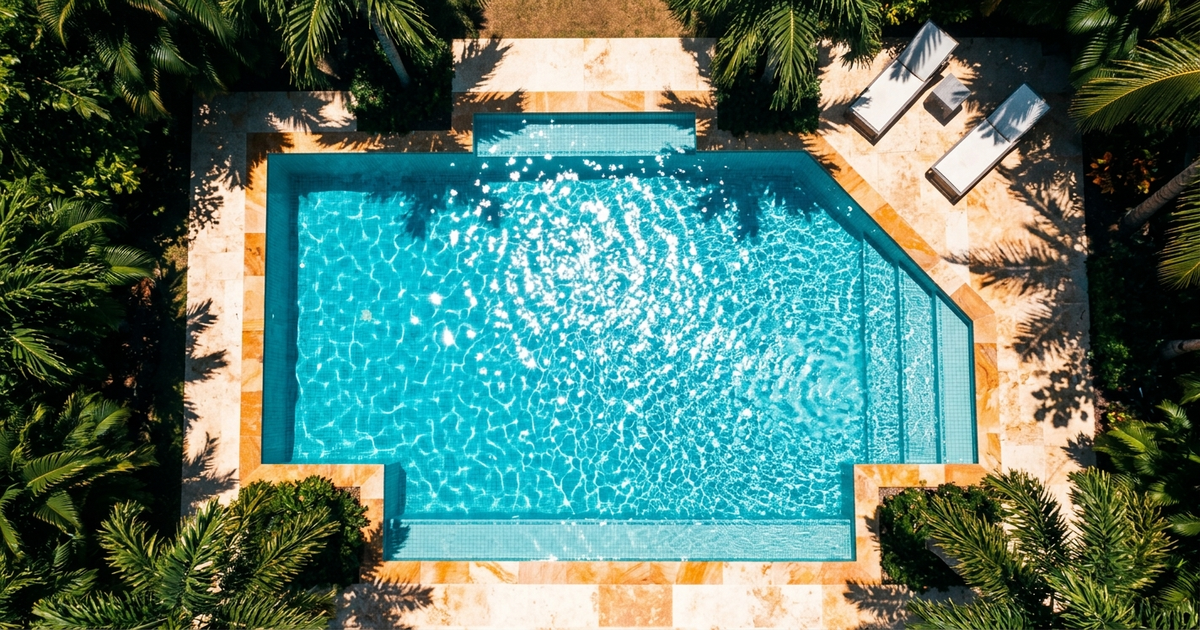
A rectangular pool holds length × width × average depth × 7.5 gallons. For a 16 by 32 foot pool with an average depth of 5 feet, that is 19,200 gallons. For round, oval, kidney, and freeform pools, the multiplier drops because the shape encloses less area than its bounding rectangle, and the wrong multiplier is why pool owners underdose chlorine and overdose acid.
Length × width × average depth × 7.5 = gallons for a rectangular pool. A 16×32 pool at 5 feet average depth holds 19,200 gallons. Round and kidney shapes use different multipliers; see the formulas below.
Volume is the first number every dose calculation depends on. A 15 percent error in volume produces a 15 percent error in every chemical you add for the life of the pool. This guide gives you the exact formula for each common shape, a measured method for average depth, and a reference table you can screenshot before you walk outside with the tape measure.
Why Volume Accuracy Matters More Than Anything Else
Every bag of shock, every jug of acid, every bucket of stabilizer assumes a pool size. Manufacturer labels round to clean numbers ("1 lb per 10,000 gallons") and your pool is never exactly 10,000 gallons. If you guess that your pool holds 20,000 gallons when it actually holds 24,000, you are underdosing by 17 percent every time you add chlorine. Run that math across a summer and the difference shows up as algae blooms after pool parties, a slow CYA climb because you keep adding more dichlor to compensate, and pH that drifts because you misjudged how much acid to add.
The flip side is just as costly. I had a neighbor convinced his pool held 30,000 gallons because the previous owner told him so. The pool was a 15 by 30 kidney with a 5 foot average depth, about 15,750 gallons. He was nearly doubling every chemical dose for two seasons. His pH crashed every Saturday after he shocked. His salt cell ran rich and the chlorinator alarm kept tripping. The fix was a tape measure and 10 minutes of math.
Under-dosing is the bigger safety concern. A pool that reads 1 ppm free chlorine when you think it has 3 ppm is not sanitized, and pathogens like Cryptosporidium and Pseudomonas need sustained chlorine residual to die off. Always test first, calculate against your real volume, and dose accordingly. For deeper coverage on translating volume into chemical amounts, see the Pool Chemical Calculator Guide.
The Constant That Makes the Formulas Work
One cubic foot of water equals 7.4805 gallons at typical pool temperatures. Most calculators round to 7.5. That is where every volume formula starts.
The reason rectangular pools use 7.5 and curved pools use less is geometry. A round pool inscribed inside a square fills about 78.5 percent of that square (π/4). An oval fills roughly the same fraction along its bounding rectangle. A kidney is a more complex curve, but it averages about 93 percent of its bounding rectangle. The multipliers you see in the formulas below are the cubic-foot-to-gallons constant (7.48) adjusted for how much of the bounding rectangle the shape actually fills:
- Rectangle / square: 7.5 (full fill)
- Round / circular: 5.9 (78.5 percent of 7.48)
- Oval / elongated round: 5.9 (same logic)
- Kidney / freeform: 7.0 (93 percent of 7.48)
- L-shape: calculate each rectangle separately at 7.5
Use these and you will land within 5 percent of true volume, which is closer than any chemical dosing actually needs.
Volume Formulas by Pool Shape
Rectangle and Square
Gallons = Length × Width × Average Depth × 7.5
Measure length and width along the inside of the coping, not the outside of the deck. Both numbers in feet. Average depth is the shallow end plus the deep end divided by two for a single-slope pool.
Example: 18 ft × 36 ft × 5 ft average depth × 7.5 = 24,300 gallons.
Round (Circular)
Gallons = Diameter × Diameter × Average Depth × 5.9
Diameter is the widest distance straight across the pool, in feet. Above-ground round pools are almost always advertised by diameter. Average depth for above-ground rounds is usually the same as the wall height minus 6 inches (since you do not fill them to the brim).
Example: 24 ft diameter × 24 ft × 4 ft × 5.9 = 13,594 gallons.
Oval
Gallons = Length × Width × Average Depth × 5.9
Length is the long axis, width is the short axis, both in feet. Same multiplier as round because an oval is geometrically a stretched circle.
Example: 15 ft × 30 ft × 4 ft × 5.9 = 10,620 gallons.
Kidney and Freeform
Gallons = Length × Width × Average Depth × 7.0
Measure length at the longest straight line you can draw inside the pool. Measure width at the widest point perpendicular to that line. The 7.0 multiplier handles the curved edges that pull area out of the bounding rectangle.
Example: 16 ft × 32 ft × 5 ft × 7.0 = 17,920 gallons.
L-Shape
Break the pool into two rectangles, calculate each, add them together.
Gallons = (Rectangle A: L × W × D × 7.5) + (Rectangle B: L × W × D × 7.5)
Most L-shaped pools have a shared depth across both legs, but if the legs slope differently, calculate average depth separately for each rectangle.
Example: Main rectangle 16 × 30 × 5 ft × 7.5 = 18,000 gallons. Extension 10 × 14 × 4 ft × 7.5 = 4,200 gallons. Total: 22,200 gallons.
True Freeform (Lagoon Style)
For pools with no clear length and width — irregular curves all the way around — the most accurate field method is the grid method:
- Draw the pool outline on graph paper, with each square representing 1 square foot.
- Count whole squares inside the outline; count partial squares as half.
- Multiply the resulting square footage by average depth × 7.48.
This sounds tedious, but it takes 15 minutes and produces a number within 3 percent of true volume. For most lagoon pools, using length × width × 7.0 will get you within 10 percent, which is close enough for chlorine but not close enough for muriatic acid.
How to Measure Average Depth (the Number Most People Get Wrong)
Average depth is where pool owners blow the calculation. The shallow end depth or the deep end depth alone is not your average depth. Neither is the depth at the deepest single point in the deep end.
For a pool with a single continuous slope from shallow to deep:
Average Depth = (Shallow End Depth + Deep End Depth) / 2
For a pool with three sections — a flat shallow shelf, a sloped transition, and a flat deep section — the simple average overestimates depth. Use the weighted method:
- Measure shallow end depth at the wall (call it A).
- Measure deep end depth at the wall (call it B).
- Measure the depth where the slope begins (typically the same as A).
- Measure the depth where the slope ends (typically the same as B).
- Use this approximation:
Average Depth ≈ ((A × shallow length) + ((A+B)/2 × slope length) + (B × deep length)) / total length
That looks complicated written out. In practice, for a 32 ft long pool with a 10 ft shallow flat at 3 ft, a 12 ft slope, and a 10 ft deep flat at 8 ft:
((3 × 10) + (5.5 × 12) + (8 × 10)) / 32 = (30 + 66 + 80) / 32 = 5.5 ft
In this case the weighted average matches the simple average because the slope is centered. If your shallow shelf is longer than your deep section, the weighted method gives a smaller, and more accurate, average depth.
Measuring Without Getting in the Pool
Drop a weighted string straight down at each measurement point. Mark the waterline on the string with a permanent marker. Pull it up and measure with a tape. A heavy bolt tied to a 12 ft length of paracord works fine. I have used this method on every pool I have owned — it beats trying to read depth markers that were painted on five owners ago and may not match current waterline.
Pool Volume Quick Reference Table
These are common dimensions with the math already done. Use the row that matches your shape and dimensions; if your pool is between two rows, interpolate or measure directly.
| Shape | Length × Width | Avg Depth | Gallons |
|---|---|---|---|
| Rectangle | 12 × 24 | 4 ft | 8,640 |
| Rectangle | 14 × 28 | 4.5 ft | 13,230 |
| Rectangle | 16 × 32 | 5 ft | 19,200 |
| Rectangle | 18 × 36 | 5 ft | 24,300 |
| Rectangle | 20 × 40 | 5.5 ft | 33,000 |
| Rectangle | 25 × 50 | 6 ft | 56,250 |
| Round | 15 ft diameter | 4 ft | 5,310 |
| Round | 18 ft diameter | 4 ft | 7,646 |
| Round | 21 ft diameter | 4 ft | 10,406 |
| Round | 24 ft diameter | 4 ft | 13,594 |
| Round | 27 ft diameter | 4.5 ft | 19,348 |
| Round | 30 ft diameter | 4.5 ft | 23,895 |
| Oval | 12 × 24 | 4 ft | 6,797 |
| Oval | 15 × 30 | 4 ft | 10,620 |
| Oval | 18 × 33 | 4.5 ft | 15,770 |
| Kidney | 14 × 28 | 5 ft | 13,720 |
| Kidney | 16 × 32 | 5 ft | 17,920 |
| Kidney | 20 × 40 | 5.5 ft | 30,800 |
| Freeform | 18 × 36 | 5 ft | 22,680 |
Standard above-ground sizes assume the wall is filled to 6 inches below the top. Inground numbers assume the waterline at the bottom of the tile band, not the coping.
Common Volume Mistakes
Using the deep end depth instead of average depth. A 3 ft shallow / 8 ft deep pool has a 5.5 ft average depth, not 8 ft. This single mistake will give you a volume 45 percent too high.
Measuring the deck instead of the water. Coping, tile, and waterline are not the same edge. A 16 by 32 ft deck might cover an 14 by 30 ft pool. Measure inside the coping or inside the tile line.
Forgetting the spa. An attached spa on shared plumbing draws from the same chemistry. A 7 ft round spa with a 3 ft depth adds about 870 gallons. If your spa shares water with the pool, add its volume to your pool volume.
Always measure your own pool, because volume numbers on bills of sale and listing sheets are wrong about half the time. A 10% volume error means every chemical dose is 10% off, compounding across chlorine, acid, and stabilizer.
Trusting the previous owner. Pool size gets repeated on bills of sale, pool service records, and listing sheets, and it is wrong in roughly half of all cases. Always measure your own pool the first time you do chemistry.
Using the salt cell rating. Salt cells are rated for a maximum pool size, not your pool size. A cell rated for 40,000 gallons does not mean your pool holds 40,000 gallons.
Ignoring the tanning ledge or beach entry. These features reduce volume compared to a straight rectangle by 5 to 10 percent. For freeform pools with a beach entry, measure the average depth across the whole shape, including the shallow ledge.
Step-by-Step: Measure Your Pool Volume in 15 Minutes
- Identify your pool shape. Rectangle, round, oval, kidney, L, or true freeform.
- Measure length. Inside the coping or tile, longest straight line. Write it down in feet.
- Measure width. Inside the coping or tile, widest perpendicular line. Write it down in feet.
- Measure shallow end depth. Drop a weighted string at the wall in the shallow end. Mark the waterline. Measure the string.
- Measure deep end depth. Same method at the deep end wall. If your deep end has a hopper or main drain pit, measure to the top of that pit, not the bottom — water in the pit is part of the volume, but the slope is what matters for average.
- Calculate average depth. Add shallow and deep, divide by two. For complex slopes, use the weighted method above.
- Apply the shape multiplier. Length × Width × Average Depth × (7.5 / 5.9 / 7.0 depending on shape).
- Round to the nearest 100 gallons. Chemical dosing does not need more precision than that.
- Write the number on a sticky note inside your pool equipment shed. Every future dose calculation will start from this number.
When You Do Not Need a Calculator
If you only adjust pH once a month and dose chlorine by the puck, you do not need a calculator for any of this. Use the reference table above, pick the closest row, and call it done. The math is forgiving at long timescales.
You need the calculator when you are dosing something that can hurt the pool if you overshoot — muriatic acid, calcium chloride, sodium bisulfate, or salt for a new saltwater conversion. Acid in particular is unforgiving: 32 ounces of 31.45 percent muriatic acid will drop a 20,000-gallon pool's pH by about 0.4, but the same dose in a 12,000-gallon pool drops pH by 0.7 and can crater your alkalinity at the same time. Volume accuracy is what separates a controlled adjustment from a guess.
For specific chemical dosing where volume drives the math, see the Pool pH Balance guide for acid, the Pool Alkalinity Guide for baking soda, and the Pool Salt Calculator Guide for saltwater conversions.
Using the Poolably Volume Calculator
The Poolably app's volume calculator supports rectangle, oval, kidney, and freeform shapes. You enter length, width, shallow depth, and deep depth; it computes average depth and applies the right multiplier for your shape. The volume saves to your pool profile, so every dosage suggestion the app makes afterward — chlorine, acid, alkalinity, salt, calcium — uses that exact number. Poolably is iOS only.
If you prefer to keep doing the math by hand, the formulas in this guide are the same ones the app uses. The point of the app is that you do not have to remember which multiplier goes with which shape, and you do not lose the number when you replace your phone.
Safety Notes on Volume and Chemical Dosing
Volume accuracy is a safety issue. Underestimating volume means underdosing sanitizer, which leaves the water unsafe for swimmers. Overestimating volume in the other direction means overdosing acid, which can drop pH below 6.8 and damage skin, eyes, and pool equipment.
When you do dose chemicals based on your calculated volume:
- Test water first with a kit or strips before adding anything.
- Add chemical to water, never water to chemical.
- Never mix two pool chemicals together, especially chlorine and acid — the reaction releases chlorine gas.
- Wear chemical-resistant goggles and gloves when handling pool chemicals.
- Store chemicals in their original containers, in a cool dry place, with oxidizers and acids kept on separate shelves.
Frequently Asked Questions
How many gallons is a 16x32 inground pool?
A 16 by 32 foot rectangular pool with an average depth of 5 feet holds about 19,200 gallons. The formula is length × width × average depth × 7.5. Use average depth (shallow plus deep divided by two), not the deep end depth alone.
How do I calculate the volume of a freeform or kidney pool?
For a kidney or freeform pool, multiply length × width × average depth × 7.0. Measure length at the longest point and width at the widest point. The 7.0 multiplier accounts for the curved edges that subtract about 7 percent from the area of a true rectangle.
How do I find the average depth if my pool has a slope?
Add the shallow end depth and the deep end depth, then divide by two. For a pool that is 3 feet at the shallow end and 8 feet at the deep end, average depth is 5.5 feet. Pools with a flat shallow shelf, a sloped transition, and a flat deep section need a weighted average across each section.
Why does pool volume matter so much for chemical dosing?
Every chemical dosage is calculated per 10,000 gallons. Underestimating volume by 20 percent means underdosing chlorine by 20 percent, which can leave the pool unsanitized after heavy use or hot weather. Overestimating wastes chemicals and pushes pH or alkalinity out of range.
What is the gallons per cubic foot of water?
One cubic foot of water equals 7.4805 gallons. Most pool calculators round to 7.5 for rectangles. Round, oval, and kidney pools use a smaller multiplier (5.9 for round and oval, 7.0 for kidney) because the shape encloses less area than its bounding rectangle.
Should I measure my pool in feet or meters?
Use feet if you want gallons. Multiplying length × width × depth in feet by 7.5 gives gallons directly. If you measure in meters, multiply length × width × depth × 264 to convert cubic meters to gallons, or use a calculator that accepts metric input and converts internally.
Sources
- ANSI/APSP/ICC-5 American National Standard for Residential Inground Swimming Pools (Pool & Hot Tub Alliance, 2011)
- CDC Model Aquatic Health Code, water volume and turnover annex (Centers for Disease Control and Prevention, 2018)
- Density of Water at Different Temperatures (National Institute of Standards and Technology)
- Pool volume measurement — field observations across rectangular, kidney, and freeform residential pools (Author experience, 2026)
# --- EDITORIAL REFERENCE (not published) ---
estimatedWordCount: 2050
cluster: "1 — Water Chemistry"
targetReadability: "8th grade or below"
seasonalRelevance: "evergreen"
productFeatureMentioned: "volume calculator — rectangle, oval, kidney, freeform"
safetyBlockIncluded: true

# --- HOWTO SCHEMA ---
howTo:
  enabled: true
  totalTime: "PT15M"
  steps:
    - name: "Identify pool shape"
      text: "Determine whether your pool is rectangle, round, oval, kidney, L-shape, or true freeform."
    - name: "Measure length"
      text: "Inside the coping or tile, measure the longest straight line in feet."
    - name: "Measure width"
      text: "Inside the coping or tile, measure the widest perpendicular line in feet."
    - name: "Measure shallow end depth"
      text: "Drop a weighted string at the shallow end wall. Mark the waterline. Measure the string."
    - name: "Measure deep end depth"
      text: "Use the same weighted-string method at the deep end wall."
    - name: "Calculate average depth"
      text: "Add shallow and deep depths and divide by two. Use a weighted average for pools with flat shallow and deep sections."
    - name: "Apply the shape multiplier"
      text: "Multiply length × width × average depth by 7.5 (rectangle), 5.9 (round or oval), or 7.0 (kidney or freeform)."
    - name: "Round and save"
      text: "Round to the nearest 100 gallons and record the number where you will see it next time you dose chemicals."

# --- IMAGE PROMPTS ---
images:
  - placement: "header"
    prompt: "A homeowner kneeling beside a residential inground pool, holding a tape measure stretched across the water surface from one tile edge to the other. Notepad on the deck with handwritten dimensions and an arithmetic sketch. Late afternoon natural light, clear water, no people in the pool. Photorealistic, slight depth of field, warm tones."
    alt: "Pool owner measuring the length of an inground pool with a tape measure and notepad on the deck"
  - placement: "after 'Volume Formulas by Pool Shape'"
    prompt: "Top-down diagram-style illustration showing six common pool shapes — rectangle, round, oval, kidney, L-shape, and freeform — each labeled with its multiplier (7.5, 5.9, 5.9, 7.0, 7.5, 7.0). Clean technical drawing style with light blue water fill and grey deck outline, white background, vector look."
    alt: "Diagram of six pool shapes with their volume formula multipliers labeled on each"
  - placement: "after 'How to Measure Average Depth'"
    prompt: "Side cross-section diagram of a swimming pool showing a 3 foot shallow end, a sloped transition, and an 8 foot deep end. Dashed line shows the 5.5 foot average depth. Measurements labeled in feet. Clean technical illustration, light blue water fill, white background."
    alt: "Cross-section diagram of a pool showing shallow end, slope, deep end, and the calculated average depth"
Frequently Asked Questions
Vlad Kuzin
Pool owner and builder of the Poolably app. I got tired of guessing at chemical doses, so I built a calculator that does the math.